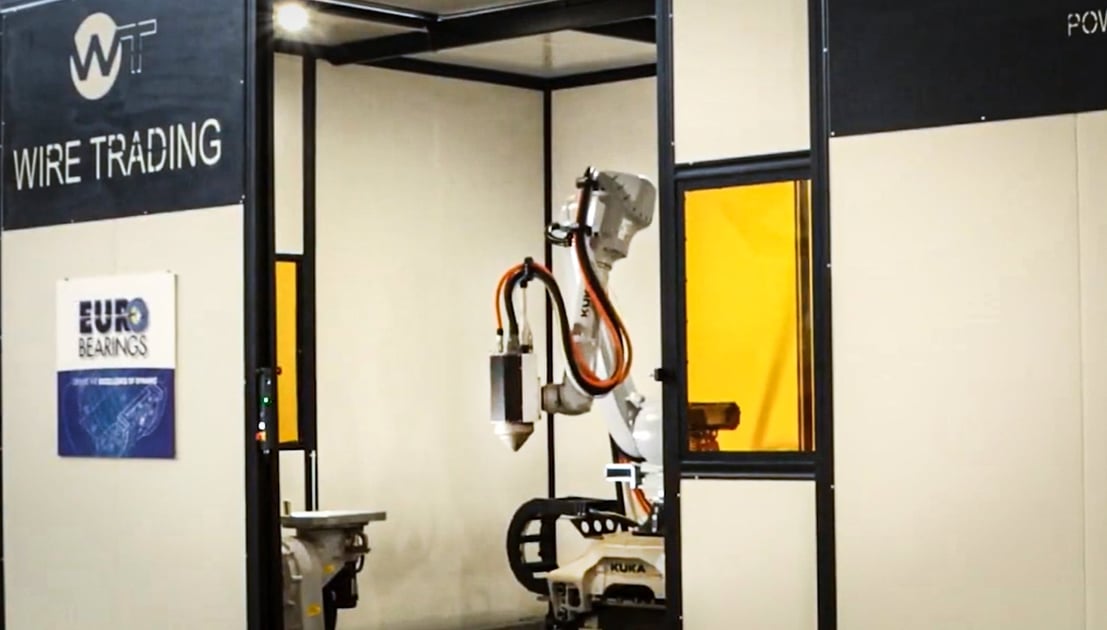
Eurobearings uses Meltio's metal wire DED to slash spare part waste by 90%

Application
Originally reported by All3DP
Italian industrial bearing specialist Eurobearings has integrated Meltio's metal wire directed energy deposition (DED) technology into its repair and production workflow, achieving a 90% reduction in material waste for large industrial spare parts. The company, headquartered in Italy, uses the Meltio M600 system to deposit 316L stainless steel and other wire alloys onto worn or damaged bearing housings and shafts, replacing weeks of traditional machining and welding with days of additive manufacturing. Eurobearings reports that the process eliminates the need for oversized stock material and reduces post-processing steps, directly cutting lead times and material costs for heavy-industry clients.
This deployment exemplifies the industrial-tooling and energy verticals' growing adoption of DED for repair and remanufacturing, a segment where subtractive methods have long dominated. Unlike powder-bed fusion (LPBF), which requires controlled atmospheres and fine powders, Meltio's wire-DED approach operates in open air with standard welding wire, making it accessible to conventional machine shops and maintenance facilities. Eurobearings' move mirrors a broader pattern where DED systems from Meltio, WAAM3D, and Lincoln Electric are displacing manual welding and casting for large-format, low-volume spare parts. The 90% waste reduction figure is significant because it addresses the core economics of heavy-industry spare part management: inventory carrying costs, long lead times, and material overconsumption. This is not a production-scale breakthrough but a targeted application of AM where the value proposition is clear and the qualification path is short, since the parts are often non-flight-critical and governed by internal standards rather than aerospace or medical regulations.
For Eurobearings, the practical next step is to expand its material qualification library beyond 316L to include tool steels and nickel-based superalloys, which would open more repair applications in oil and gas and power generation. For the broader AM industry, this case reinforces that DED's strongest near-term ROI is in repair and remanufacturing, not net-shape production. Buyers evaluating DED should focus on total cost per repaired part, including post-processing, rather than deposition speed alone.
Topics