E3D launches Bastion DLC-coated extruder gears for Bambu Lab printers

Hardware
Originally reported by 3D Printing Industry
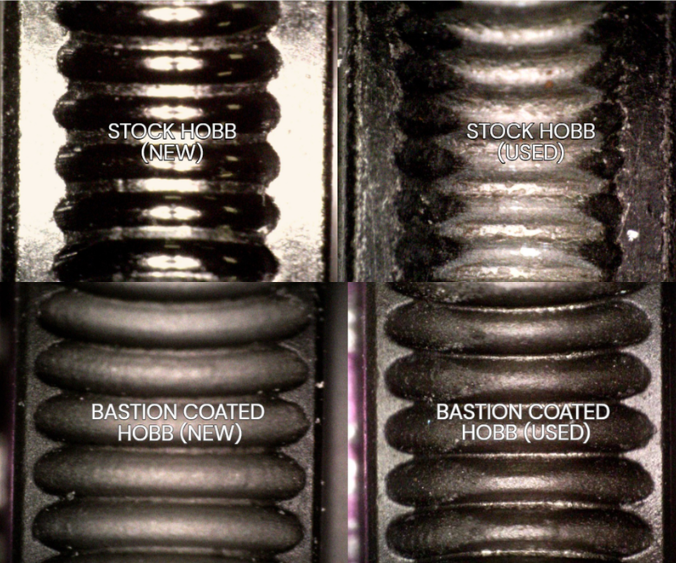
UK-based extrusion specialist E3D has launched Bastion Coated Gears, a hardened steel extruder gear and hobb upgrade for Bambu Lab X1C, X1E, P1P, and P1S desktop printers. The components feature a Diamond-Like Carbon (DLC) coating applied via Physical Vapour Deposition (PVD) sputtering, measuring 0.005 mm thick. E3D reports the coating achieves a dry coefficient of friction of 0.1 against steel, compared to approximately 0.6 for Titanium Nitride (TiN). Internal testing showed coated gears running dry outperformed lubricated uncoated gears by five times in tooth contact cycles, and with minimal lubrication exceeded two million contact cycles before testing was stopped.
This launch targets a specific wear mode in the desktop polymer extrusion segment: sliding wear on extruder drivetrain components during prolonged use with abrasive filaments such as carbon fiber-filled, glass-filled, and glow-in-the-dark materials. The product addresses a gap in the aftermarket ecosystem for Bambu Lab printers, which have achieved significant market penetration but whose stock extruder components may degrade under sustained technical-filament use. E3D is positioning Bastion as a reliability upgrade rather than a performance enhancer, reflecting a maturing desktop AM market where users increasingly prioritize repeatable print quality over raw speed. The coating's self-lubricating graphite-like carbon component and reported 10-15% increase in load-carrying capacity suggest E3D has applied tribological engineering principles more commonly seen in industrial metal AM to the polymer desktop space.
For Bambu Lab users running production batches with filled materials, this is a practical maintenance upgrade that addresses a known failure mode before it manifests as inconsistent extrusion or clogs. E3D must now demonstrate that the coating's durability holds up across real-world print environments beyond controlled lab testing, and that the 0.005 mm tolerance preservation translates to measurable improvements in long-term print consistency. The product is a sensible incremental improvement for a specific user pain point, not a platform shift.
Topics