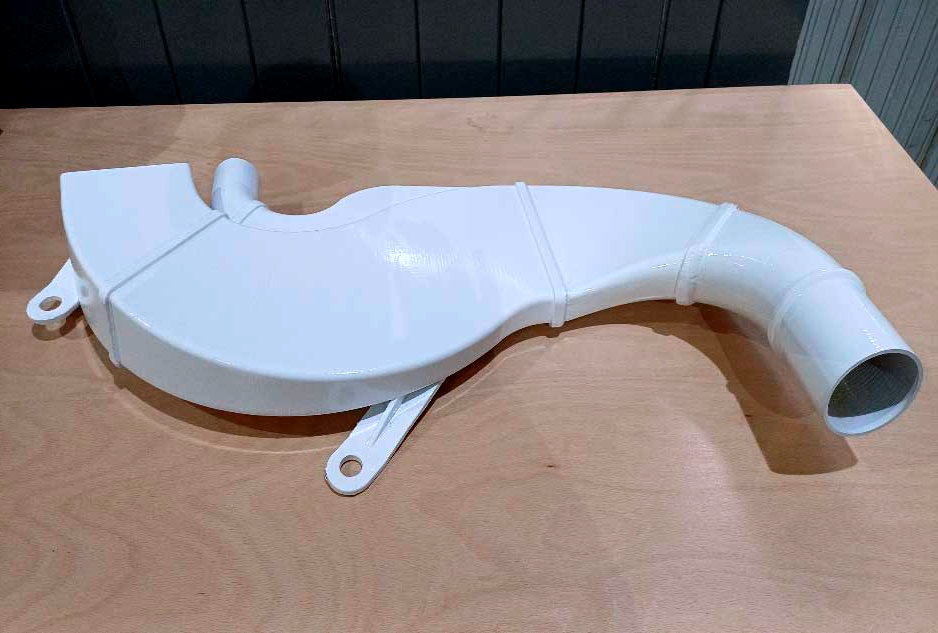
RBSL adopts miniFactory Ignite 3D printing for Challenger 3 battle tank air ducting

Application
Originally reported by TCT Magazine
Rheinmetall BAE Systems Land Limited (RBSL) has deployed a miniFactory Ignite material extrusion system to produce polymer air ducting components for the Challenger 3 main battle tank's Crew Temperature Control System. The application, reported on July 3, 2026, involves a vehicle design upgrade cycle where the ducting's form factor repeatedly changed as more critical subsystems were integrated into the tank architecture. RBSL turned to in-house polymer additive manufacturing to accommodate design iterations without retooling costs, given the low production volumes typical of military vehicle programs.
This deployment fits the broader pattern of defense organizations adopting in-house polymer AM for non-structural, low-risk components to compress supply chain timelines and enable design flexibility during complex platform upgrades. The Challenger 3 program, a UK Ministry of Defence effort, represents the kind of program-duration, qualification-heavy environment where AM often disappears from headlines precisely when it succeeds - embedded as infrastructure rather than novelty. RBSL's choice of the miniFactory Ignite, a pellet- or filament-fed system targeting production-grade parts, suggests a shift from prototype-only use toward repeatable production of end-use polymer parts in a defense context. The economic logic here hinges on avoiding hard tooling for parts that may change multiple times during a multi-year vehicle integration phase.
For defense primes and their suppliers, this case demonstrates that the practical value of polymer AM in 2026 lies not in replacing high-volume metal production but in solving exactly this class of problem: late-stage design volatility in low-volume, high-complexity platforms. RBSL's next execution step will be qualifying the Ignite's output to meet military standards for temperature resistance and mechanical performance, a necessary gate before expanding the part list beyond comfort systems.
Topics