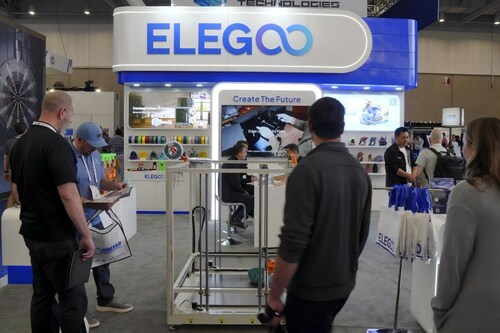
Elegoo closes 500M yuan B+ round to close software gap with Bambu Lab

Hardware
Originally reported by 3D Printing Industry
Elegoo (Shenzhen SmartPie Technology Co.) has completed a B+ round of over 500 million yuan (approximately $73.3 million), led by Meituan and its investment arm Dragon Ball Capital, alongside Guoce Capital, Hillhouse Capital, Minghui Zhiyuan Capital, Shenzhen Capital Group, Shanghai High-Tech Investment Group, and Yintai Capital. The round closed less than six months after DJI took a strategic stake in the company. Co-founder and vice president Chen Bo stated the funds will be deployed for senior talent hiring, R&D, global operations scaling, and supply chain strengthening. Elegoo reported 2025 revenue of 2.3 billion yuan ($328.5 million), up from 1.6 billion yuan in 2024 and 1 billion yuan in 2023, but acknowledged a widening competitive gap with rival Bambu Lab, now at roughly a 4:1 revenue ratio in Bambu Lab's favor.
This funding round is a defensive response to what the company internally calls the "Bambu Effect" - a software-driven competitive moat that has little to do with hardware specs. Bambu Lab machines now maintain stable operation for over a month between resets, while Elegoo systems require recalibration every two weeks. That gap is purely algorithmic: firmware and slicing software accumulated over time, not hardware tolerances. Elegoo's product development failure between late 2024 and early 2025 - a delayed machine that shipped only as a monochrome version overseas, with no domestic release - was fundamentally a code failure. The company is now working to internalize DJI's system-level hardware-software integration methodology, and Meituan's 770 million annual active users provide a distribution channel for scaling that approach. This is a classic case of the IP lock-in grind pattern (P3), where the moat is embedded in software workflows and qualification data, not in the printer chassis.
For Elegoo, the practical challenge is execution speed: absorbing DJI's methodology and translating it into firmware improvements that close the recalibration gap will take at least two product cycles. The Meituan partnership provides distribution leverage, but the core problem remains algorithmic - and algorithmic moats compound faster than hardware iteration can match. Buyers evaluating polymer FFF/FFF printers in the prosumer segment should treat recalibration frequency as a spec sheet metric as important as build volume or print speed. Elegoo's revenue growth trajectory is healthy, but without closing the software gap, the 4:1 revenue ratio with Bambu Lab will widen further.
This article is an AI-assisted rewrite of the linked source report. Facts originate from the source; phrasing is AMPulse's. Use Read Original below to verify, or Report an issue if something is wrong.