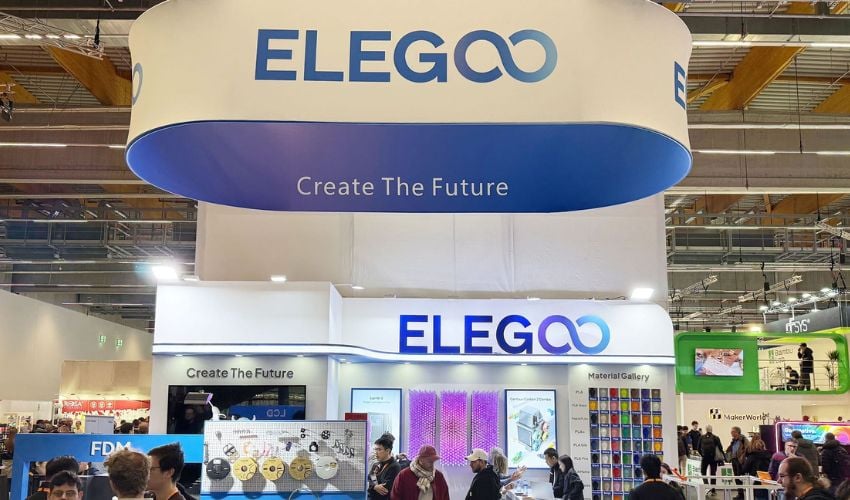
ELEGOO closes $70M Series B+ led by Meituan's DragonBall Capital, six months after DJI-backed Series B

Hardware
Originally reported by 3DNatives
ELEGOO has raised over 500 million yuan (approximately $70 million) in a Series B+ funding round led by Meituan's DragonBall Capital, with co-investment from Shenzhen Capital Group, Hillhouse Investment, Yintai Group, and Shenzhen HTI Group. The round comes just six months after a similarly sized Series B in November 2025 that included participation from drone giant DJI. The company, historically self-funded by its three co-founders and known for refusing outside investment, has now raised over $140 million in two tranches within six months. Co-founder Chen Bo described the shift as a deliberate "reform" driven by the realization that internal resources could no longer keep pace with competitors' product cycles, particularly in engineering for mass production.
This funding sequence is a rare and significant structural pivot for a company that long operated as an independent, bootstrapped player in the consumer polymer AM market. ELEGOO's move from isolation to aggressive capital-raising, with DJI as both investor and operational mentor, mirrors the Chinese localization arc pattern: a domestic entrant leverages supply-chain depth and manufacturing scale to close a gap with an established leader - in this case, Bambu Lab. The company is adopting DJI's product development and firmware methodologies, not copying them outright but internalizing the systems behind them. ELEGOO's stated 2026 revenue target of RMB 3.5–4.0 billion ($512–585 million) still leaves a roughly fivefold gap to Bambu Lab, but the company is explicitly not aiming for a quick overtake. Instead, Chen frames the goal as survival through the "settlement phase" of the consumer desktop AM market, where reliability and usability - making printers as dependable as household appliances - will determine which players remain.
From an analyst perspective, the practical question is whether ELEGOO can translate this capital and DJI's operational blueprint into a materially better user experience at scale, without overextending into product lines that dilute focus. The company's admission that its 2023 product delays stemmed from mass-production engineering limits is honest and actionable. The next 12 months will show whether the reformed development pipeline can deliver machines that close the reliability gap with Bambu Lab's ecosystem, or whether the funding simply buys time in a market where switching costs for consumers remain low. For buyers, the signal is that ELEGOO is now a serious contender in the high-volume consumer segment, but execution on firmware and quality control will determine whether that translates into market share.
This article is an AI-assisted rewrite of the linked source report. Facts originate from the source; phrasing is AMPulse's. Use Read Original below to verify, or Report an issue if something is wrong.