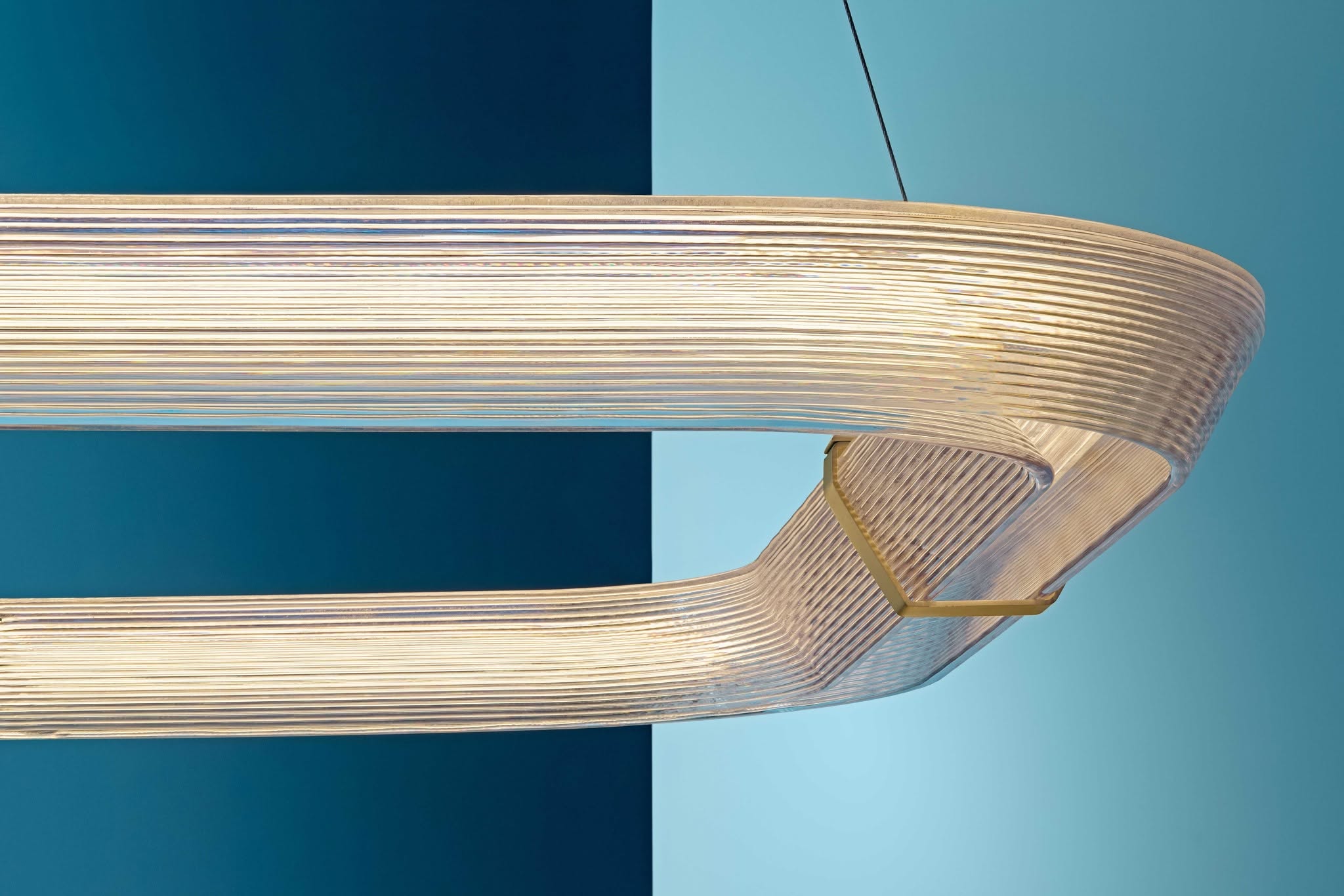
Eureka's River Luminaire Series Debuts LFAM for Decorative Lighting

Application
Originally reported by 3D Printing Industry
Montreal-based lighting manufacturer Eureka, part of the Acuity Brands portfolio, has launched the River Luminaire series, a collection of 13 decorative lighting fixtures that marks its first use of large-format additive manufacturing (LFAM). The fixtures are produced in partnership with Florida-based Haddy, which operates a microfactory equipped with CEAD Flexbot robotic LFAM systems featuring integrated milling and AI-assisted platforms. All 13 fixtures share a translucent polymer body built through robotic LFAM, with the printer's characteristic layering used as an aesthetic element to create light-and-shadow effects when the internal LED is activated. The series spans six form families - linear, square, oblong, ring, lagoon, and freeform - and offers pendant or surface mounting options with selectable metal bracket finishes for hospitality, corporate, and civic interiors.
This launch fits a recurring pattern in which additive manufacturing moves from purely functional or industrial applications into design-led commercial segments where geometric freedom and production speed outweigh per-unit cost premiums. Eureka is following a path already validated by Philips MyCreation, which partnered with McDonald's to install custom 3D-printed light fixtures across 38,000 global locations using recyclable materials and local production. For Eureka, LFAM compresses development cycles and enables organic geometries that traditional molding or extrusion cannot replicate at comparable tooling cost. The partnership with Haddy also demonstrates how microfactory models - small-footprint facilities with robotic AM cells - can serve as production partners for established brands without requiring those brands to internalize AM expertise. The lighting segment represents a modest but growing demand vertical for polymer AM, driven by customization needs in commercial interiors and the ability to produce low-to-medium volumes without hard tooling.
From a practical standpoint, this is a measured commercial deployment rather than a technology breakthrough. Eureka and Haddy have executed a design-led product line that uses LFAM's visible layer lines as a deliberate aesthetic feature rather than a surface defect to be hidden. The real test will be whether the River series achieves repeat orders at volumes that justify the microfactory production model, and whether the partnership can scale to additional fixture families without compromising lead times or unit economics. For buyers in hospitality and corporate design, the key takeaway is that LFAM now offers a viable path to custom lighting geometries at lead times that conventional fabrication cannot match, provided the aesthetic of printed layering aligns with the intended interior language.
Topics