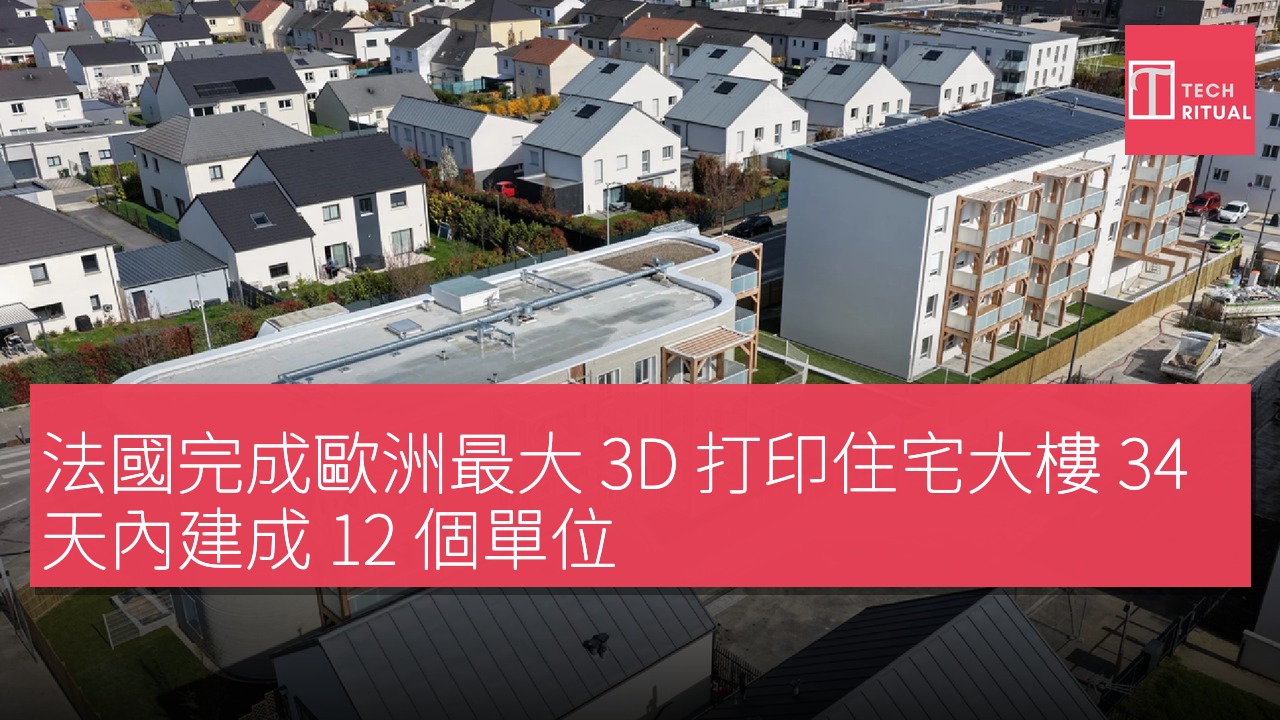
Plurial completes Europe's largest 3D-printed apartment building in 34 days in France

Application
Originally reported by techritual.com
French social housing operator Plurial Novilia has completed the ViliaSprint2 project, a three-story, 12-unit apartment building in France, using large-scale concrete 3D printing. The structural walls were printed on-site over 34 days using a computer-controlled nozzle extruding a specially formulated cement mixture designed to achieve rapid curing while maintaining extrudability - a rheological balance not required in conventional concrete. The project follows Plurial's 2021 single-story ViliaSprint prototype and represents a meaningful scale-up from proof-of-concept to a multi-unit social housing block. Interior fit-out including plumbing, electrical, insulation, and finishes remains conventional, meaning the 34-day figure applies only to the printing phase, not total project delivery.
This project fits the recurring pattern of construction-scale AM moving from novelty demonstrations toward economically motivated adoption, driven by labor shortages and cost pressure in European social housing. The concrete printing process used here is a variant of material extrusion (MEX) at building scale, distinct from industrial metal or polymer AM processes. The key editorial lesson is that speed claims require scope discipline: the 34-day print window is impressive against traditional masonry timelines, but the full construction schedule including fit-out and regulatory approval remains longer. Structural engineering challenges persist - printed concrete walls exhibit anisotropic mechanical behavior, with layer-bond strength as the primary failure mode, requiring additional load testing and case-by-case engineering approvals under building codes not originally written for additive methods. Reinforcement integration also remains a logistical hurdle, with fiber-reinforced concrete only partially substituting for traditional rebar in tension-critical applications.
From an industry perspective, this is a measured step forward for construction AM in regulated European markets, not a breakthrough that rewrites building economics overnight. The capital cost of dedicated printing equipment, scarcity of trained operators, and lack of codified building standards for printed concrete mean each project still requires bespoke engineering validation, adding time and expense that offset some of the labor savings. Plurial's progression from a single-story prototype to a three-story, 12-unit building is the right trajectory, but the technology's path to widespread adoption in social housing depends on standardization bodies developing clear structural design rules and on equipment vendors reducing system costs through fleet deployment rather than one-off installations.
Topics