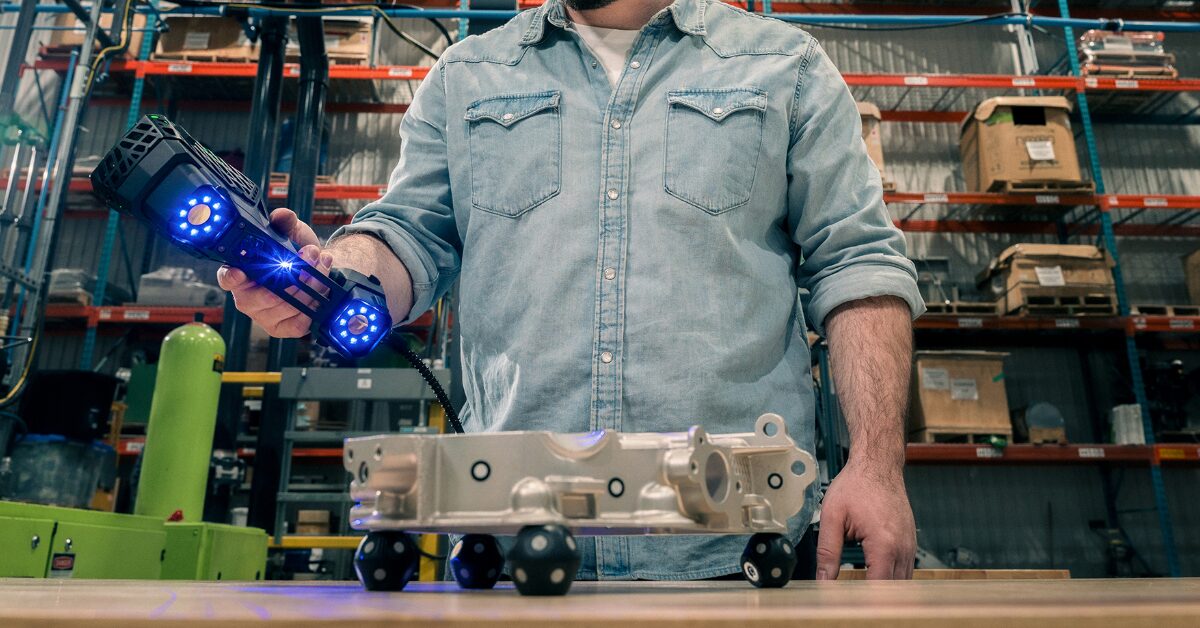
FARO CREAFORM launches four new HandySCAN portable 3D scanners including EVO and MAX EVO Elite

AM-Adjacent Equipment
Originally reported by 3Druck
FARO CREAFORM has expanded its HandySCAN 3D family with four new portable scanners: the HandySCAN EVO, EVO Plus, MAX EVO, and MAX EVO Elite. The MAX EVO achieves a volumetric accuracy of 0.150 mm + 0.020 mm/m, while the MAX EVO Elite tightens this to 0.075 mm + 0.010 mm/m, targeting high-tolerance inspection and non-destructive testing. All models operate on the Creaform Metrology Suite, integrating scanning, analysis, and reporting, and can be used wirelessly with a mobility kit for on-machine or on-platform inspection. The devices are calibrated per ISO/IEC 17025 and comply with VDI/VDE 2634 standards for optical 3D measurement systems.
This launch addresses a persistent gap in the additive manufacturing workflow: post-process quality assurance for large-format and complex geometries. While metal PBF-LB and polymer SLS/MJF systems have scaled build volumes, the metrology tools to verify those parts-especially freeform surfaces and internal features-have remained tethered to fixed CMM rooms. The HandySCAN MAX EVO series directly competes with GOM ATOS and Hexagon Absolute Arm scanners, but differentiates on portability and wireless operation, reducing the need for dedicated inspection cells. For AM service bureaus and aerospace suppliers, this means faster first-article inspection loops and reduced fixture costs. The integration of QR-code-driven inspection programs also lowers the skill barrier for production-floor operators, a practical step toward scaling AM quality governance beyond metrology specialists.
From a practical standpoint, the key question is whether the MAX EVO Elite's 0.075 mm + 0.010 mm/m accuracy holds under real factory-floor conditions-temperature drift, vibration, and operator variability. FARO CREAFORM's VDI/VDE 2634 compliance provides a defensible baseline, but users should validate against their own reference artifacts for critical aerospace or medical applications. For most tooling and prototyping workflows, the standard MAX EVO at roughly half the accuracy spec is likely sufficient. The real win here is the mobility kit: eliminating the need to transport large printed parts to a fixed scanner saves hours per inspection cycle in high-mix, low-volume production environments.
Topics