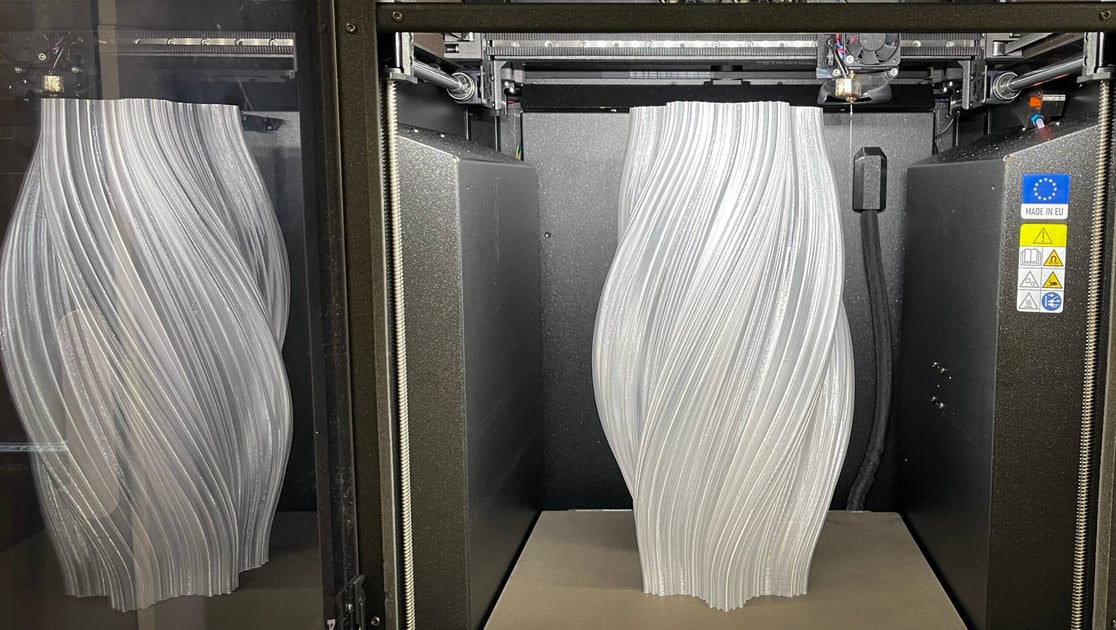
Fillamentum launches rePETG Loopfill recycled PETG filament with verified print quality

Materials
Originally reported by All3DP
Fillamentum, the Czech Republic-based premium filament manufacturer, has launched rePETG Loopfill, a recycled PETG filament that the company claims matches the mechanical strength, transparency, and printability of virgin PETG. The product was subjected to three months of internal and beta-user testing before release, with results indicating no significant compromise in layer adhesion or optical clarity compared to standard PETG. The filament is produced from post-industrial PETG waste, processed through a closed-loop recycling system at Fillamentum's facility in Hulin.
This launch enters a polymer material extrusion (FDM/FFF) market where recycled filaments have historically struggled to gain traction among professional users due to inconsistent diameter tolerance, reduced mechanical properties, and poor surface finish. Fillamentum's rePETG Loopfill directly challenges that perception by positioning itself as a drop-in replacement rather than an eco-compromise. The move reflects a broader industry trend toward circular material streams in desktop and prosumer AM, where material cost and waste reduction are becoming competitive differentiators. Competitors such as Reflow, Filamentive, and Polymaker's recycled lines have established the category, but Fillamentum's reputation for tight tolerances and consistent quality in its standard PETG line gives rePETG a credibility advantage among engineering and design users who previously avoided recycled materials.
For users, the practical takeaway is straightforward: rePETG Loopfill eliminates the need to recalibrate print profiles or accept lower part quality when choosing a recycled material. Fillamentum must now demonstrate that production scale can maintain the consistency demonstrated in testing, as batch-to-batch variation has historically been the Achilles' heel of recycled filaments. If the company executes on quality control, this product could shift the default choice for PETG users toward recycled material without requiring an ideological commitment to sustainability.
Topics