Formlabs launches Tough 1000, Tough 2000 Resins for SLA, targeting HDPE/PP/ABS replacement

Hardware
Originally reported by ShareLab
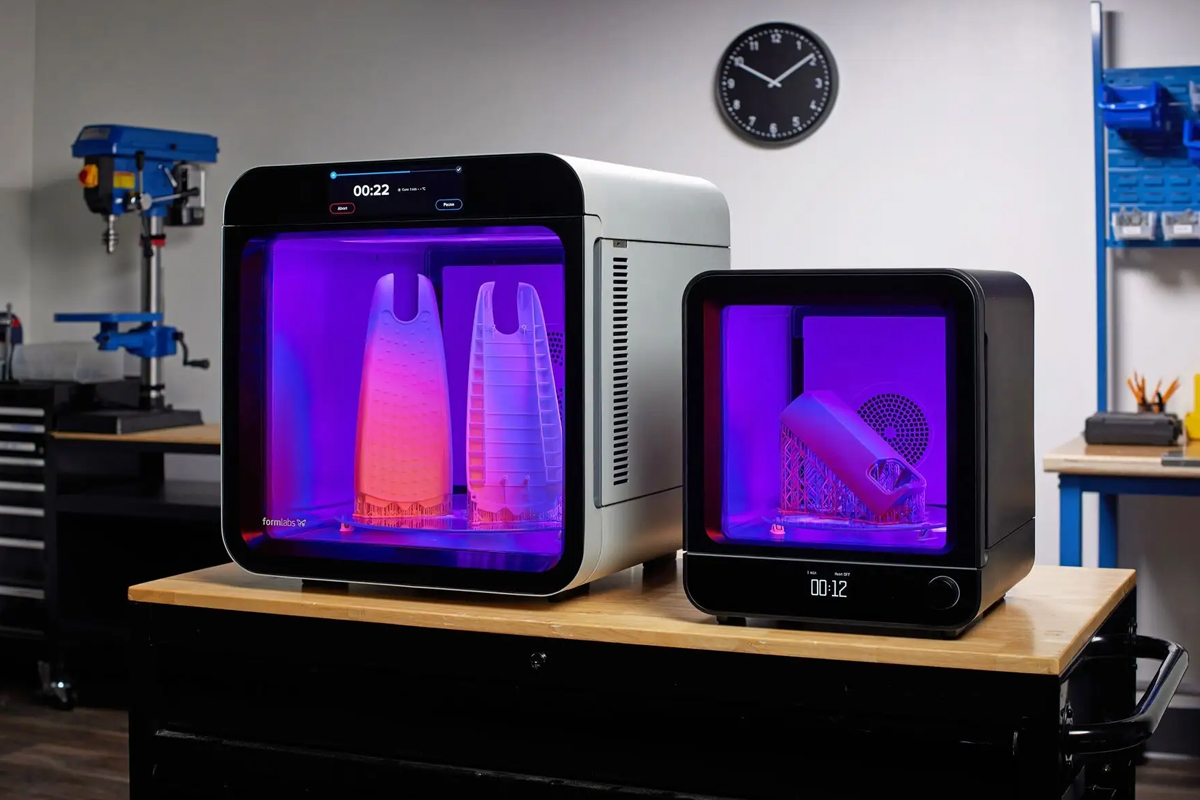
Formlabs, the Somerville, Massachusetts-based SLA 3D printing manufacturer, announced on November 13, 2025, a new family of engineering photopolymers: Tough 1000 Resin and Tough 2000 Resin, joining the existing Tough 1500 Resin. The materials are named by tensile modulus and benchmarked against common thermoplastics: Tough 1000 targets HDPE, Tough 1500 targets polypropylene, and Tough 2000 targets ABS. The company also introduced the Form Cure L V2, a secondary curing station designed for the Form 4L large-format printer, capable of completing post-cure for most parts in under 60 seconds. PreForm 3.54 was released with a new Supports V2 algorithm, measurement tools, and improved CAD assembly import and part packing features.
This release is significant not for a breakthrough in photopolymer chemistry, but for how it reframes SLA's position in the production landscape. Formlabs is directly competing with injection-molded commodity thermoplastics by offering a drop-in property match to HDPE, PP, and ABS - materials that dominate jigs, fixtures, functional prototypes, and low-volume end-use parts. The real advance is workflow integration: combining material properties that eliminate the need for a separate thermoplastic printer with a post-cure oven that dramatically reduces cycle time for large parts. This addresses the long-standing criticism that SLA's secondary curing step creates a production bottleneck, and that photopolymers lack the toughness for functional applications. The new PreForm software enhancements reduce manual support generation and preparation time, lowering the labor cost per part. This is an incremental but meaningful step toward making SLA a more complete production tool for industrial tooling and consumer product development, not just prototyping.
From a practical standpoint, the most important metric here is whether Tough 1000 and Tough 2000 hold up under real repeated loads and environmental exposure - early user testimony from Cool Machines, cited in the release, suggests positive results in sub-zero durability testing. Formlabs must now demonstrate batch-to-batch consistency and long-term material data sheets that engineers can use for design validation. For users, this family reduces the need to maintain multiple material platforms for parts that resemble common thermoplastics, potentially simplifying supply chains for small-batch production. The Form Cure L V2's short cycle time is a concrete operational improvement for shops running Form 4L printers, but the material properties will ultimately determine whether this moves beyond prototyping into repeatable production.
Topics