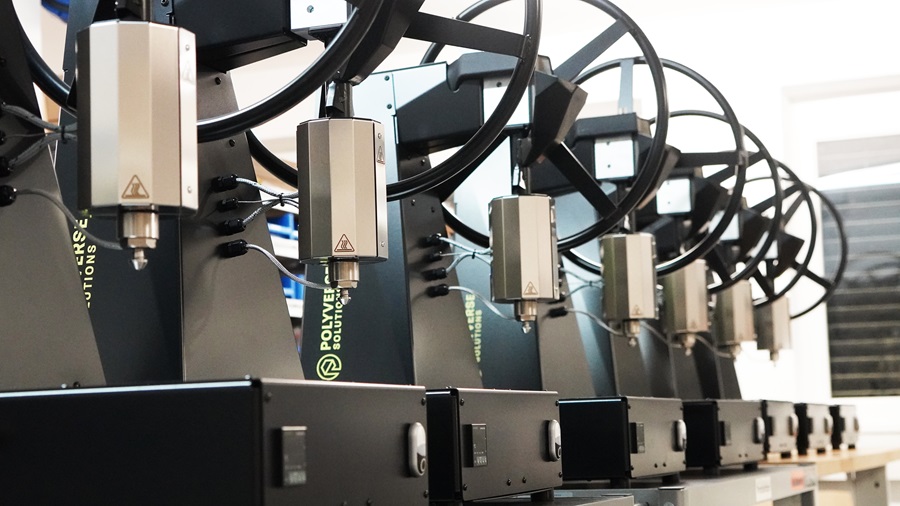
Polyverse Solutions launches NOVA-60 compact injection molding machine with 3D-printed molds

Hardware
Originally reported by 3Druck
Polyverse Solutions has introduced the NOVA-60, a compact injection molding machine designed for R&D labs and small-scale production environments, with shipments beginning in April 2026. The system uses a universal mold system that accepts inserts produced via SLA or FDM 3D printing, bypassing the need for machined metal tooling. It handles shot weights up to 60 grams, injection pressures up to 200 bar via a manual handwheel, and processing temperatures up to 350°C, enabling use with technical polymers and filled compounds. Measuring 58 x 40 x 100 cm and weighing 50 kg, the NOVA-60 is already deployed at Prusa Research and in development departments of several European industrial firms, according to the company.
The NOVA-60 occupies a narrow but strategically important niche: bridging the gap between purely additive prototypes and serial injection molding by allowing engineers to produce parts in production-grade thermoplastics with realistic mechanical behavior, using 3D-printed tooling. This addresses a persistent pain point in product development - the cost and lead time of metal molds for functional testing and low-volume pilot runs. The machine competes indirectly with desktop injection systems from companies like Babyplast and Galomb, but its key differentiator is the explicit integration of 3D-printed mold inserts, which collapses the tooling cycle from weeks to days. Polyverse Solutions is also planning a broader workflow ecosystem, including a lab-scale granulator for internal recycling, a mold temperature controller, and additional modular mold systems, positioning the 3D-printed mold insert as a connective tissue between prototyping and low-volume production.
For the AM industry, the NOVA-60 is a practical, incremental tool rather than a category shift. Its value depends on execution: the company must deliver reliable, repeatable mold inserts from standard SLA and FDM materials, and ensure the clamping and injection system can withstand repeated use without degrading part quality. Buyers should verify that the 200-bar injection pressure is sufficient for their target materials and geometries, and that the mold insert durability matches their expected run lengths. This is a focused product for a specific workflow gap, not a general-purpose manufacturing platform.
Topics