FUGO Precision 3D to debut centrifugal 3D printing technology at LMT LAB DAY Chicago 2026

Hardware
Originally reported by ShareLab
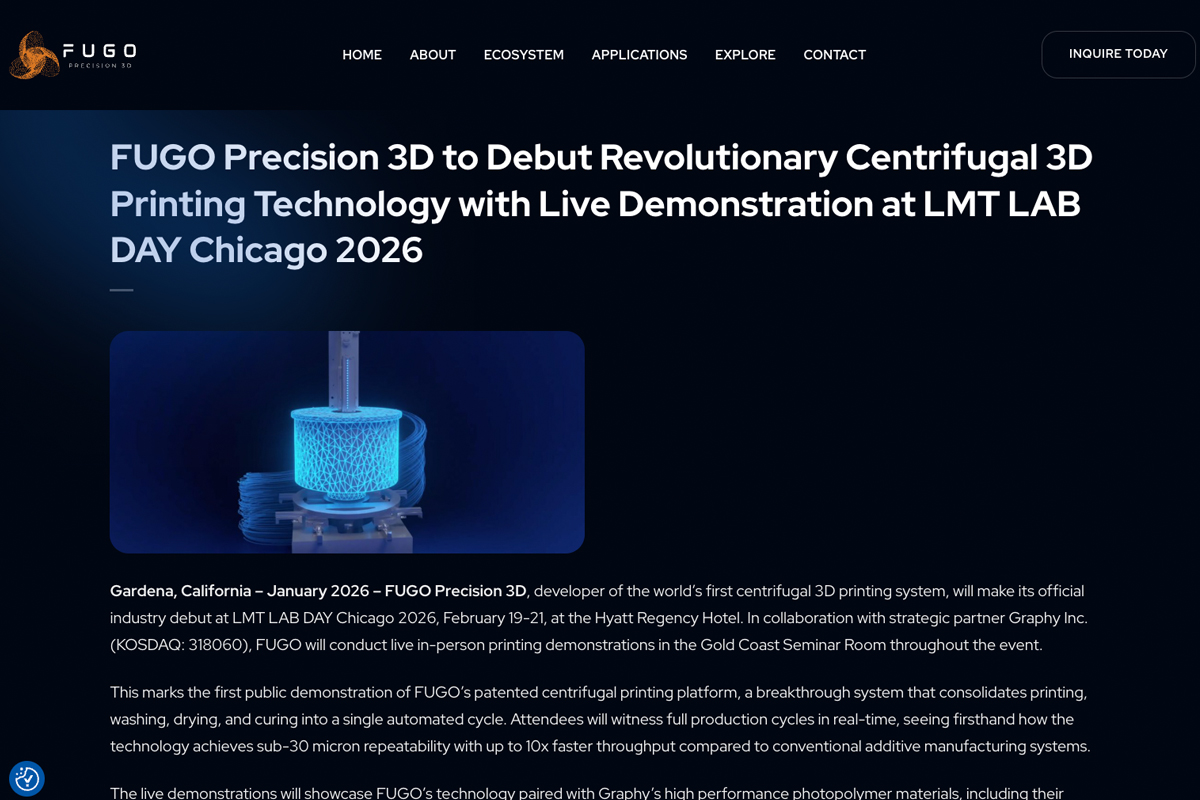
California-based startup FUGO Precision 3D will publicly demonstrate its proprietary centrifugal 3D printing system for the first time at LMT LAB DAY Chicago 2026, held February 19-21, 2026. The company, in partnership with Korean photopolymer specialist Graphy Inc. (KOSDAQ:318060), will conduct live fabrication demonstrations in the Gold Coast Seminar Room, showcasing a system that integrates printing, washing, drying, and UV curing into a single automated cycle. FUGO claims the technology achieves up to 10x higher throughput than conventional vat photopolymerization systems while maintaining repeatable accuracy below 30 microns. The company has also launched an Early Access Partner Program offering dental laboratories a 90-day evaluation period ahead of commercial release.
This announcement targets a well-documented bottleneck in dental additive manufacturing: post-processing labor. While material performance and print resolution in the dental segment have matured significantly over the past five years, the manual steps of washing, drying, and curing remain a persistent cost center for labs producing aligners, models, and surgical guides at scale. FUGO's approach - collapsing the full workflow into a single machine cycle - directly addresses the operational economics that determine whether a dental lab can run unattended overnight or reduce headcount per production line. The partnership with Graphy, which supplies shape-memory aligner materials and biocompatible resins, gives FUGO a credible material ecosystem from day one. The competitive field here includes established vat photopolymerization OEMs like Stratasys (Origin), 3D Systems (Figure 4), and Carbon, all of whom offer some degree of workflow integration, but none have yet commercialized a centrifugal architecture that eliminates separate wash and cure stations entirely.
From a practical standpoint, the key question is whether FUGO's centrifugal method can deliver the dimensional stability and surface finish that dental labs require across a full production shift, not just a demo cycle. The 30-micron repeatability claim is promising but needs independent validation under real lab conditions - temperature variation, resin batch differences, and continuous operation. The Early Access Program is the right move: dental labs are conservative buyers who need to see yield data and per-part cost before switching workflows. If FUGO can demonstrate consistent output with minimal operator intervention, this technology could carve a meaningful niche in the high-throughput aligner and model production segment, where labor cost is the dominant variable.
This article is an AI-assisted rewrite of the linked source report. Facts originate from the source; phrasing is AMPulse's. Use Read Original below to verify, or Report an issue if something is wrong.
Topics