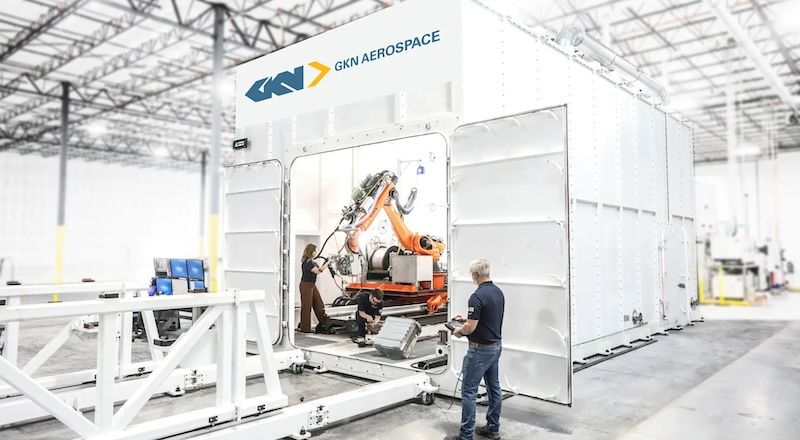
GKN Aerospace and the US Air Force Research Laboratory have launched the $8.4 million TITAN-AM program to industrialize Laser Metal Deposition with Wire (LMD-w) for large-scale titanium aerostructu...
Originally reported by aerospacetestinginternational.com
GKN Aerospace and the US Air Force Research Laboratory have launched the $8.4 million TITAN-AM program to industrialize Laser Metal Deposition with Wire (LMD-w) for large-scale titanium aerostructures. The collaboration, based at GKN Aerospace’s Global Technology Centre in Fort Worth, Texas, focuses on five technical pillars: process development for large-scale components, creation of robust material datasets, advanced simulation methods, tailored non-destructive inspection techniques, and final structural demonstration. David Bond, GKN Aerospace’s chief technology officer for airframes, is leading the initiative to transition LMD-w from lab-scale research to operational aerospace production environments.
This program addresses the critical need for cost-effective, high-rate production of large titanium parts, a segment where traditional subtractive manufacturing remains inefficient due to high buy-to-fly ratios. While LPBF is dominant for smaller, complex geometries, LMD-w offers higher deposition rates and lower material costs for large-scale structural airframe components. By focusing on certification-ready datasets and NDT protocols, GKN is targeting the primary barriers to adoption in the defense and commercial aerospace sectors. This effort aligns with broader industry trends to reduce titanium waste and shorten lead times for critical structural assemblies.
Successful execution of TITAN-AM requires GKN to move beyond prototype demonstrations and establish repeatable, high-fidelity process control that satisfies stringent military airworthiness standards. For aerospace OEMs, the value of this program lies in the eventual availability of validated, large-scale titanium structures that can be integrated into existing supply chains without compromising structural integrity. The focus on NDT and simulation is the correct technical priority to ensure that LMD-w parts meet the rigorous fatigue requirements of flight-critical hardware.
This article is an AI-assisted rewrite of the linked source report. Facts originate from the source; phrasing is AMPulse's. Use Read Original below to verify, or Report an issue if something is wrong.