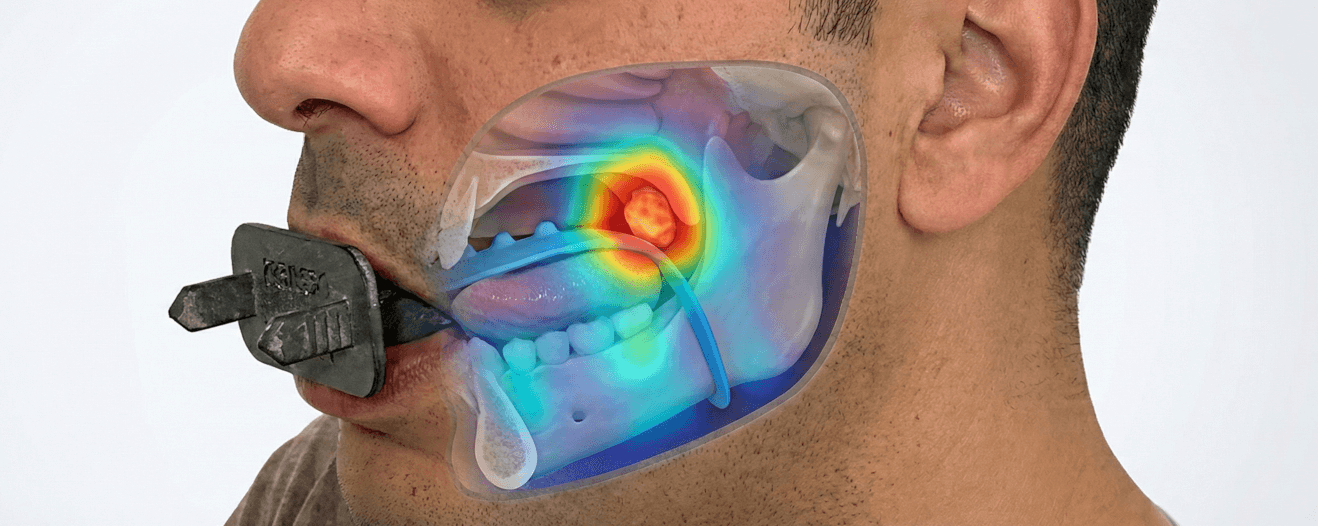
Kallisio delivers patient-specific Stentra device for head and neck cancer patient in 72 hours

Hardware
Originally reported by 3D ADEPT
Kallisio, a technology-enabled solutions company focused on precision oncology, engineered, manufactured, and delivered a patient-specific intraoral positioning device for a head and neck cancer patient named Gia within 72 hours. The device, called Stentra, is designed to support consistent immobilization during external beam radiation therapy, protecting oral health throughout treatment. Gia discovered Kallisio through her own research and reached out directly; by the end of her radiation therapy, her care team noted significantly fewer oral complications than expected. The case demonstrates a clinically viable workflow for patient-specific AM devices in oncology, moving from patient contact to delivered device in three days.
This case matters because it addresses a persistent gap in medical AM: the translation of design-to-print capability into a repeatable, clinically integrated service that operates on hospital timelines. Most patient-specific AM in oncology remains confined to surgical guides and anatomical models, not active therapeutic devices that must meet immobilization and radiation-transparency requirements. Kallisio’s Stentra sits at the intersection of vat photopolymerization (VPP) for biocompatible materials and clinical workflow engineering, a segment frontier where few companies have built end-to-end service economics. The 72-hour turnaround is notable because it aligns with the typical radiation therapy planning window, meaning the device can be incorporated into the treatment protocol rather than added as an afterthought. This is a service-led model, not a hardware sale, which shifts value capture toward the clinical integration layer rather than the printer itself.
For Kallisio, the practical next step is scaling this workflow beyond single-patient cases into a reproducible service that hospital systems can adopt without custom engineering each time. The company needs to demonstrate that the 72-hour turnaround is not a one-off sprint but a standard operating procedure supported by DfAM software, material qualification, and regulatory documentation. For buyers - radiation oncology departments - the key question is whether Stentra reduces oral mucositis rates enough to justify the per-patient cost and workflow change. This is a small, focused proof point, not a platform play, and its value will be determined by how many Gia-like cases Kallisio can convert into routine referrals.
Topics