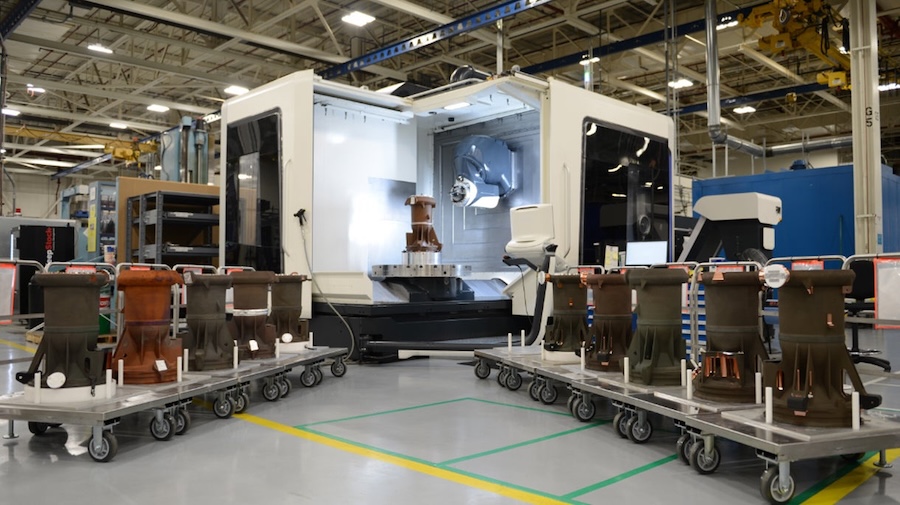
L3Harris Technologies is utilizing laser powder bed fusion (LPBF) to manufacture satellite thruster components, including nozzles, manifolds, and combustion chambers, at its Dayton...
Originally reported by Defence Industry Europe
L3Harris Technologies is utilizing laser powder bed fusion (LPBF) to manufacture satellite thruster components, including nozzles, manifolds, and combustion chambers, at its Daytona Beach, Florida facility. By transitioning from traditional subtractive machining to additive manufacturing, the company aims to reduce production lead times for propulsion systems by up to 12 months, down from the historical 18-month average. Kristin Houston, President of Space Propulsion and Power Systems, confirmed that these additively manufactured components, primarily fabricated from niobium, are currently flight-proven on national security satellites. The company is scaling production by operating multiple LPBF machines in parallel to meet the demand for rapid deployment of space assets.
This move highlights the critical role of additive manufacturing in mitigating supply chain bottlenecks within the defense and aerospace sectors. While competitors like Aerojet Rocketdyne and Northrop Grumman have also integrated AM into propulsion systems, L3Harris is focusing on high-volume scalability to address the specific needs of national security missions. The shift toward additive production for high-performance metals like niobium allows for more efficient material utilization and complex geometries that traditional machining cannot achieve. This development reflects a broader trend of defense contractors moving from prototyping to series production of flight-critical hardware.
L3Harris has successfully addressed the primary challenge of variability in LPBF processes through rigorous testing and standardized digital design workflows. To sustain this production rate, the company must maintain strict quality control across its machine fleet to ensure consistent material properties in every batch. Buyers and stakeholders should focus on the company's ability to maintain these production rates as they expand the use of AM to other platforms, such as the RL10 engine for the Vulcan rocket.
This article is an AI-assisted rewrite of the linked source report. Facts originate from the source; phrasing is AMPulse's. Use Read Original below to verify, or Report an issue if something is wrong.
Topics