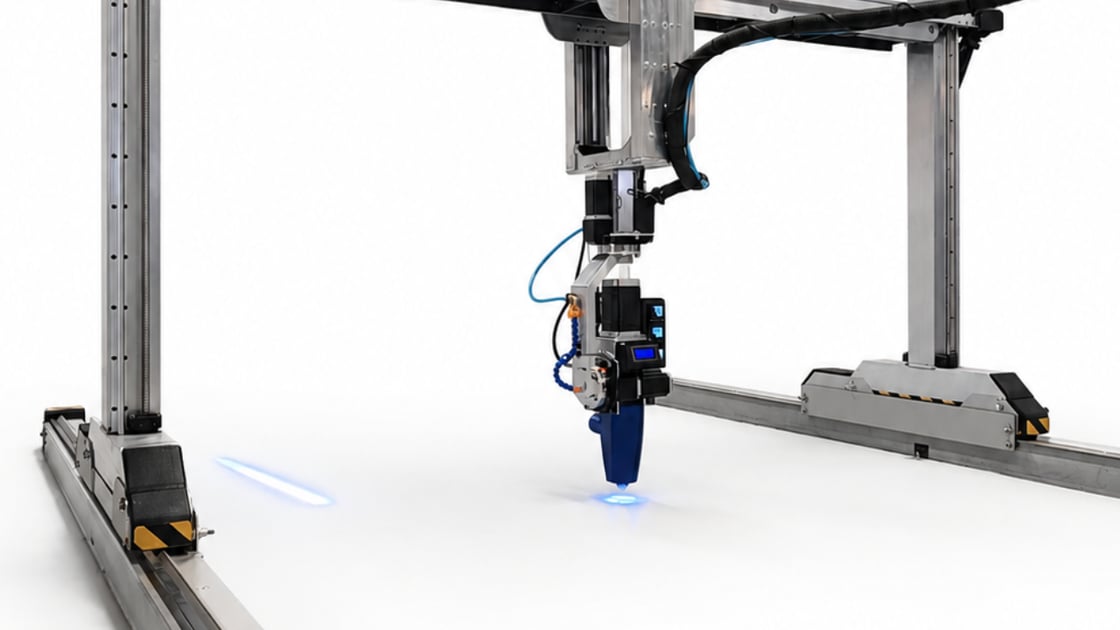
ErectorBot Launches À La Carte Large-Format Gantry Systems for Custom LFAM

Hardware
Originally reported by All3DP
ErectorBot, a US-based pioneer in large-format additive manufacturing (LFAM), has introduced a new à la carte gantry system product line, allowing customers to configure build volumes, extrusion rates, and material compatibility on a modular basis. The company, which has operated for 12 years primarily in the industrial tooling and pattern-making verticals, now offers gantry sizes ranging from 2m x 2m x 2m up to 10m x 5m x 3m, with options for pellet-fed or filament-fed extrusion heads capable of processing thermoplastics such as ABS, PC, and carbon-fiber-reinforced composites. The systems are designed for customers who need LFAM capacity but want to avoid the fixed-configuration lock-in typical of turnkey machines. Pricing is quoted per configuration, with delivery timelines of 8–12 weeks for standard builds.
This launch positions ErectorBot within the growing LFAM segment, where the competitive field includes players like Cincinnati Incorporated, Caracol, and CEAD. The à la carte approach addresses a persistent gap in the LFAM market: many industrial buyers need custom build envelopes for large tooling, patterns, or molds but cannot justify the cost of a fully integrated, proprietary system. By decoupling the gantry frame from the extrusion head and control software, ErectorBot enables users to scale capacity incrementally and swap components as materials or throughput requirements evolve. This modularity is particularly relevant for the industrial tooling and energy verticals, where part geometries vary widely and production volumes are low. The move reflects a broader trend in AM hardware toward platform-based architectures that reduce upfront capital risk and extend system lifespan through upgradeability rather than replacement.
For buyers evaluating LFAM, the practical takeaway is that ErectorBot’s offering lowers the entry barrier for custom large-format production, but the real test will be in service and support-specifically, how quickly the company can deliver and commission systems across multiple sites. The company must now demonstrate that its modular approach does not compromise reliability or material consistency compared to integrated systems. For now, this is a sensible product expansion that gives industrial users more flexibility without overpromising on throughput or material breadth.
Topics