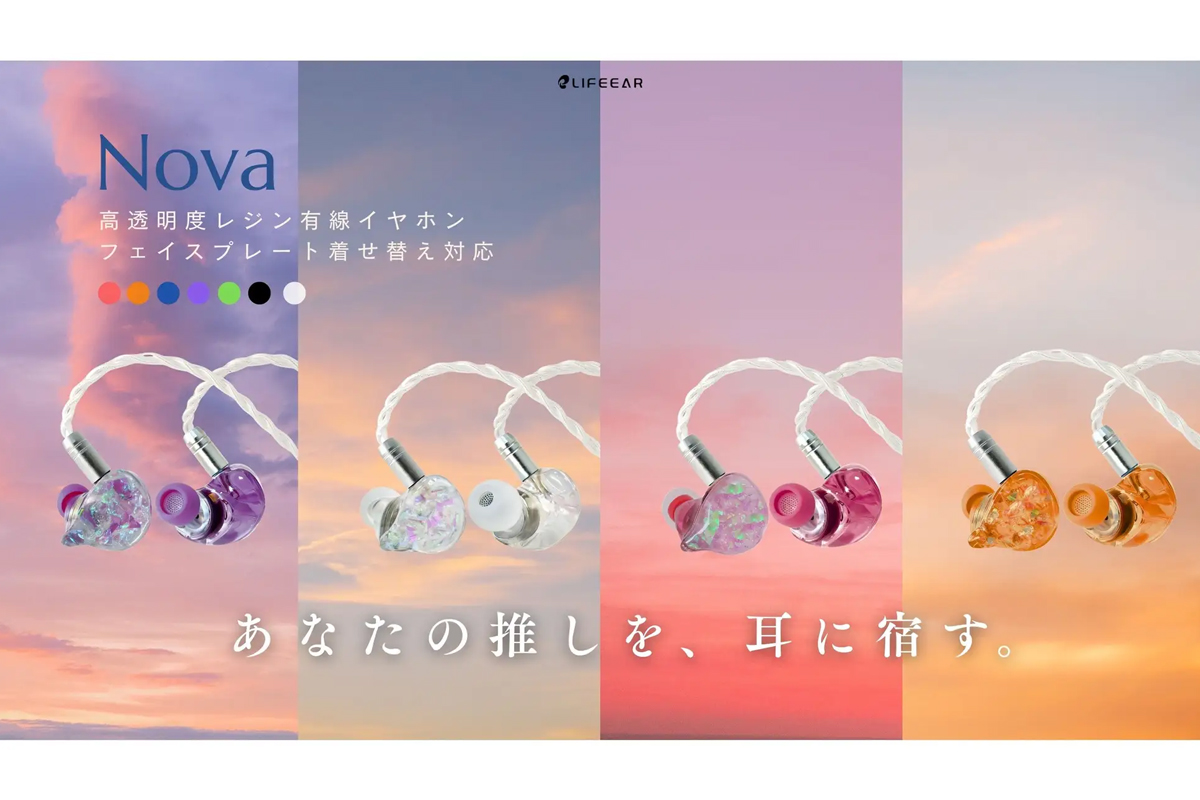
lifeear launches customizable 3D-printed wired earphones 'Nova' at Yodobashi Camera stores

Originally reported by ShareLab
Japanese audio brand lifeear has launched its customizable 3D-printed wired earphones, the Nova, at four Yodobashi Camera retail locations in Japan. Priced at 12,800 yen (approximately $90 USD), the Nova features a high-transparency resin shell produced via vat photopolymerization (VPP) and interchangeable faceplates in seven colors. The earphones use a 10mm dynamic driver, a flat 2-pin connector, and a silver-plated copper cable, with sensitivity rated at 107dB and impedance at 16 ohms. Sales began in late May 2026 at Yodobashi Camera stores in Akihabara, Umeda, Kyoto, and Hakata.
This launch represents a targeted application of VPP technology in the consumer audio segment, specifically bridging the gap between custom in-ear monitors (IEMs) used by professional musicians and mass-market earphones. lifeear is leveraging 3D printing to achieve smooth curved geometries that improve fit and passive noise isolation, while the interchangeable faceplates tap into the growing "oshi-katsu" (fan culture) trend in Japan where consumers personalize accessories with favorite colors. The product sits at the intersection of polymer VPP's design freedom and the consumer electronics vertical, where AM adoption has been driven by companies like Apple for structural components, but less so for direct-to-consumer audio products. The retail partnership with Yodobashi Camera provides a physical touchpoint for a product category where AM's value proposition - fit, customization, and aesthetic differentiation - can be demonstrated in person.
For lifeear, the Nova is a modest but strategically sound product: it uses well-established VPP technology for a niche that values both audio performance and personalization, without requiring the high qualification costs of medical or aerospace applications. The key execution challenge will be managing inventory of interchangeable faceplates and ensuring consistent resin quality across production batches. For the broader AM industry, this is a small but clean example of how VPP can serve a differentiated consumer product at a price point that justifies the manufacturing method, without overpromising on scale or disruption.
Topics