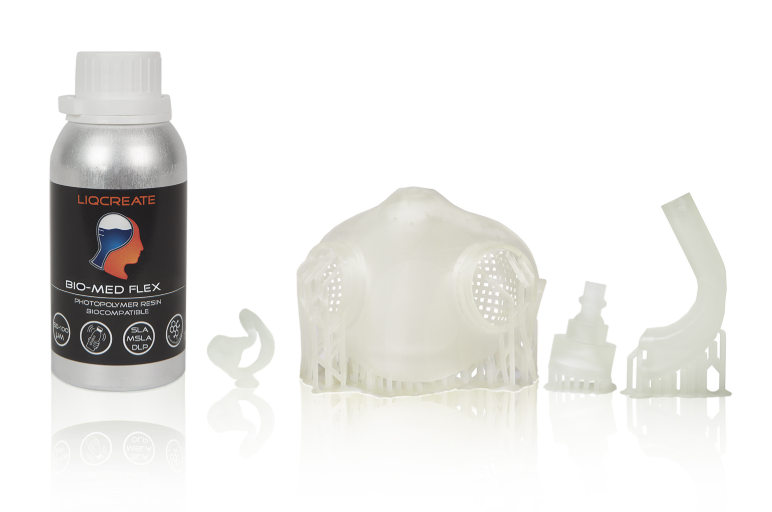
Liqcreate Launches Bio-Med Flex, a Sterilizable Flexible Photopolymer Resin for 3D Printing

Materials
Originally reported by 3D Printing Industry
Netherlands-based independent resin manufacturer Liqcreate has launched Bio-Med Flex, a clear flexible photopolymer resin designed for sterilizable, biocompatible medical and biomedical applications. The material offers a Shore A hardness of 73, tensile strength of 5.0 MPa, and elongation at break between 180 and 250%, with tear strength between 20 and 28 kN/m. Critically, parts processed through Liqcreate's specified workflow can pass cytotoxicity testing under ISO 10993-5:2009, sensitization testing under ISO 10993-10:2021, and irritation testing under ISO 10993-23:2021. The validated workflow requires two ultrasonic wash cycles in IPA or ethanol, a 60-minute ambient dry, a 10-minute submerged UV cure at 405 nm, and a 120-minute thermal cure at 60°C, making the certification workflow-dependent rather than inherent to the liquid resin.
This launch addresses a persistent gap in the medical 3D printing materials market. Rigid biocompatible resins have been available for years and are now routine in dental and surgical guide workflows, but they cannot serve applications requiring flexibility: anatomical models that deform under load, wearable sensor housings, or soft fixtures that must bend repeatedly without cracking. Industrial elastomers can fill these roles but require expensive, slow, and typically outsourced processing. Bio-Med Flex positions itself as the flexible counterpart to Liqcreate's Bio-Med Clear, which has been in clinical use for over three years. The material is compatible with DLP, LCD, and SLA printers, meaning it can run on the desktop-class hardware already installed in clinical prototyping labs. Sterilization data shows manageable degradation: after steam sterilization at 121°C, tensile strength drops from 5.0 to 3.7 MPa and elongation from 240% to 183%, while disinfection with IPA or ethanol has almost no effect on mechanical properties.
For clinical labs already running biocompatible rigid resins, Bio-Med Flex adds a flexible option without requiring new hardware or outsourced elastomer processing. The practical constraint is workflow discipline: the ISO certifications are only valid when the full post-processing sequence is followed, meaning labs must invest in a Formlabs Formcure or equivalent thermal cure unit. This is a materials qualification discipline requirement, not a product limitation. Liqcreate's next step is to build user confidence through documented case studies showing the material surviving multiple autoclave cycles in actual surgical tool or anatomical model use.
Topics