Lumafield launches Neptune Performance and Triton Performance X-ray CT platforms for real-time quality intelligence

Hardware
Originally reported by TCT Magazine
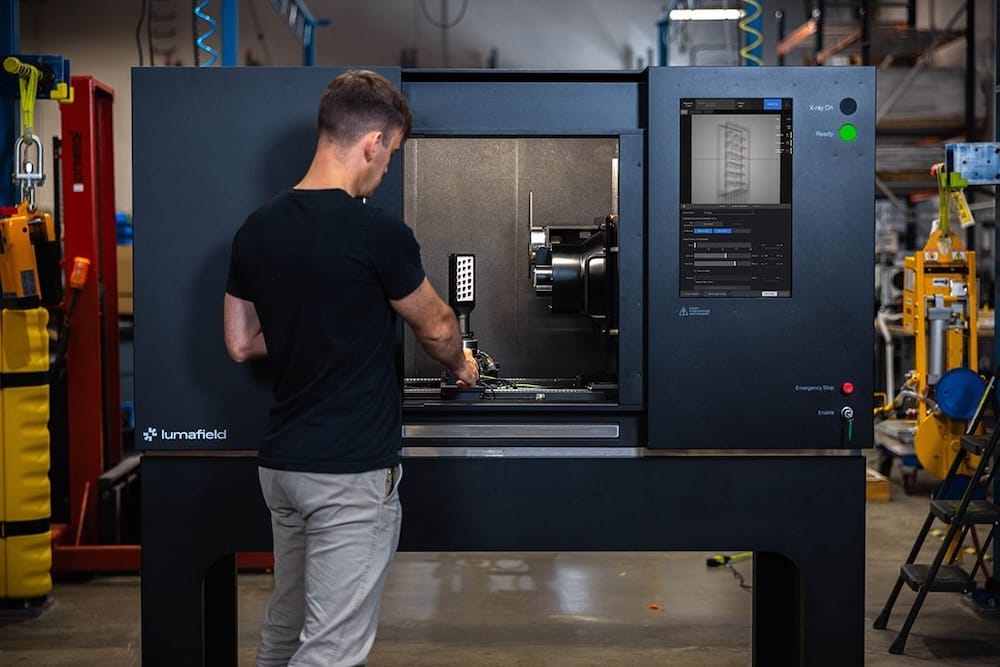
Lumafield has launched two new industrial X-ray CT scanning platforms designed to embed non-destructive inspection directly into production workflows. The Neptune Performance, an upgrade to the company's 2022 desktop CT scanner, claims 12x faster scans and 4x improved data quality, achieving micron-level accuracy on internal features in production parts. The Triton Performance targets factory-floor deployment, generating complete volumetric CT reconstructions in as little as 10 seconds per part using automated inspection recipes that can flag deviations without specialized staff. Both platforms feed into Lumafield's cloud-based Voyager software, creating a single "quality thread" that links R&D measurement templates to automated production inspection, allowing GD&T studies and failure-mode data to follow each part across the organization.
This launch addresses a persistent bottleneck in metal AM serial production: the gap between lab-grade CT metrology and high-speed factory inspection. For LPBF and binder jetting processes, internal defect detection has remained slow and operator-dependent, limiting AM's ability to scale beyond low-volume aerospace and medical parts where full CT is common. Lumafield's approach - linking R&D measurement plans to automated factory-floor recipes - effectively creates a traceable quality loop that could reduce post-processing inspection costs by eliminating separate CMM programming and fixturing. This mirrors the broader AM industry shift from machine-centric metrics to system-level quality governance, where software-defined inspection workflows become the binding layer between prototype validation and volume production. The platform's ability to handle transparent plastics, flexible materials, and aluminum also broadens its relevance beyond metal AM into polymer MJF and SLS applications where internal porosity detection remains challenging with traditional NDT methods.
For AM production managers, the practical question is whether Lumafield's temple-sharing approach meaningfully reduces the qualification burden across multiple part families, or whether each new geometry still requires custom measurement setup. The 10-second scan cycle on Triton Performance is fast enough for inline sampling but not yet for 100% inspection of high-throughput automotive lines. Lumafield's next execution step will be demonstrating that Voyager's cloud-based thread can manage inspection data across diverse printer fleets and multiple factory sites without creating integration bottlenecks. The real test is not scanning speed but whether the system can capture defect populations that correlate with process drift early enough to prevent scrap.
Topics