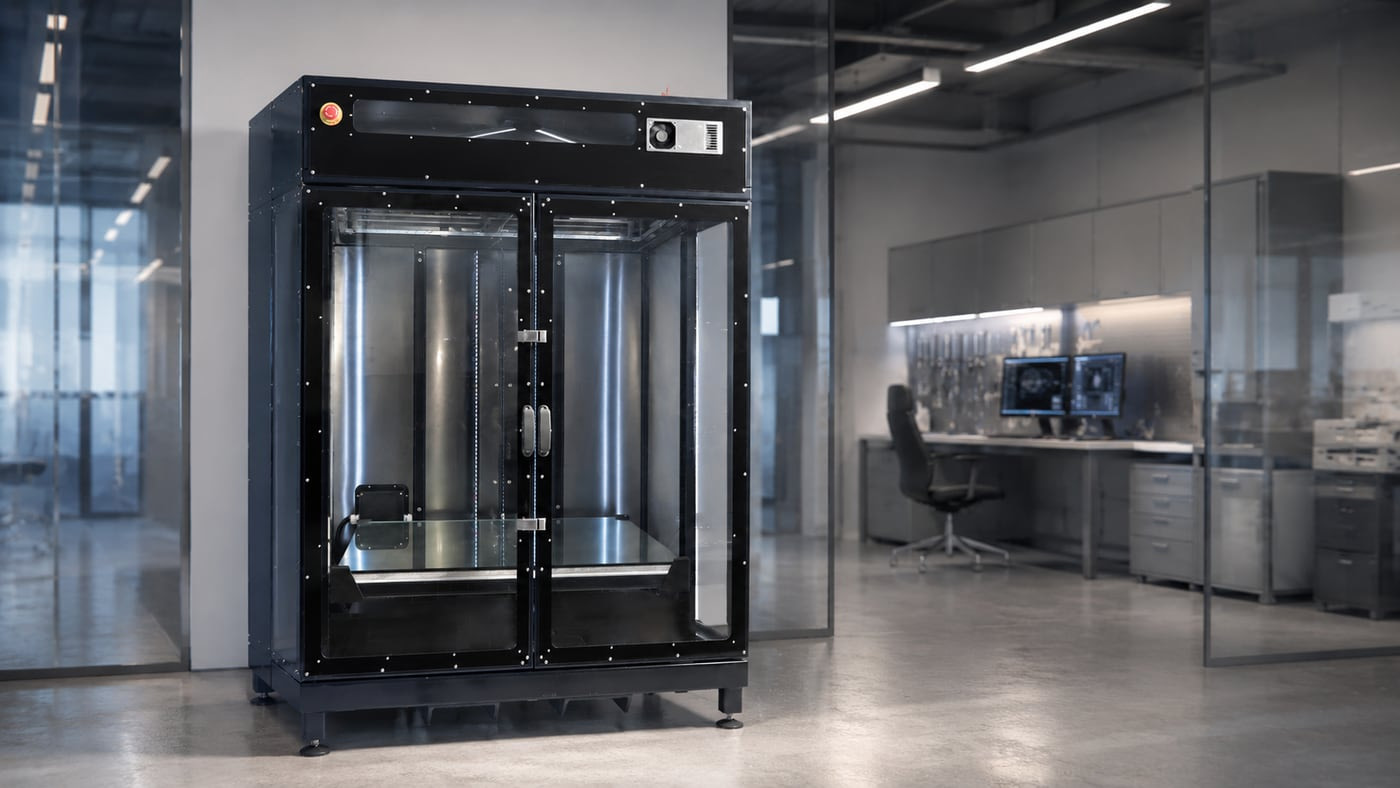
Mach-3D GmbH launches SAM 800 large-area FDM system for industrial plastic components

Service
Originally reported by 3Druck
Mach-3D GmbH, based in Altenholz near Kiel, Germany, has launched the SAM 800, a large-format FDM system designed for industrial plastic components. The system offers a build volume of 900 × 900 × 1000 mm, a printing speed of up to 500 mm/s, and a material throughput of 400 g/h. It targets service providers and manufacturers seeking to produce large technical plastic parts-such as enclosures, covers, prototypes, and spare parts-without assembly or external fabrication. The company plans its first public showcase at Formnext 2026, where it will discuss applications, material strategies, and cost-effectiveness with industrial users.
This launch addresses a persistent gap in polymer AM: the economic production of large-format technical parts. Most service bureaus rely on established FDM, SLS, or SLA processes, but scaling up build volume introduces challenges in machine rigidity, thermal management, and extrusion consistency that desktop-derived systems cannot solve. Mach-3D’s SAM 800 is engineered as a standalone industrial system with a steel frame, ball screw drives, and self-locking trapezoidal drives, positioning it against competitors like BigRep and Stratasys in the large-format FDM segment. The system targets verticals including mechanical engineering, automotive, yacht building, mold making, rail, and industrial maintenance-areas where demand for large plastic components is growing but where traditional methods require gluing or assembling smaller printed parts. This move reflects a broader shift from prototyping to production-grade tooling and end-use parts in polymer AM, where repeatability and calculable post-processing economics are critical for service bureau adoption.
For Mach-3D, the SAM 800’s success hinges on execution: the company must demonstrate that its patented drive system and modular architecture deliver consistent results across multiple materials and part geometries, and that the cost per part is competitive with conventional manufacturing for low-to-mid volumes. Service providers evaluating the system should focus on material throughput, shrinkage behavior, and post-processing requirements-not just build volume-to determine whether large-format FDM fits their existing workflow and customer base. The Formnext 2026 showcase will be the first real test of market reception.
Topics