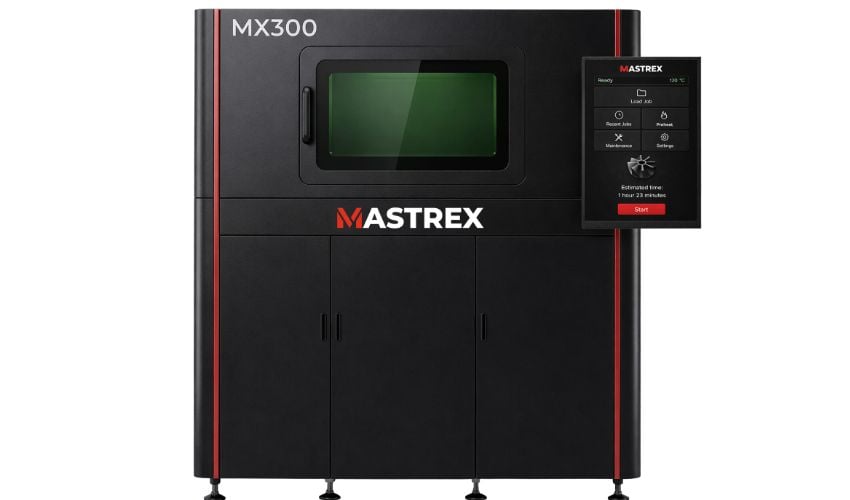
Mastrex launches MX-Series metal DMLS systems starting at $39,000, targeting aerospace and defense

Hardware
Originally reported by 3DNatives
Mastrex, a US-based laser technology company, has entered the metal additive manufacturing market with its MX-Series of DMLS (direct metal laser sintering) systems, priced from $39,000 for a compact benchtop model up to $185,000 for the larger MX-300 platform. The MX-300 offers adjustable laser beam diameters from 50 to 120 microns, layer heights between 20 and 120 microns, and a build rate of up to 70 cm³ per hour. It supports materials including stainless steel, titanium, aluminum, cobalt-chrome, copper, and Inconel. The company positions these as hybrid systems combining pre-qualified material and software parameters with open-configuration options for advanced users. Early applications span aerospace components such as heat exchangers, turbine parts, and combustion chambers, as well as defense, dental, and research use cases.
This launch fits the recurring pattern of cost-driven market expansion in metal PBF-LB, where new entrants leverage mature laser and optics supply chains to undercut incumbent pricing by roughly 3x. Mastrex follows a trajectory similar to earlier desktop polymer AM democratization, but in a segment where qualification burden and material certification remain high. The $39,000 entry point directly challenges the notion that industrial-grade metal AM requires $500,000+ capital investment, potentially opening the technology to small machine shops, university labs, and defense subcontractors. However, the real frontier question is whether Mastrex can turn these affordable machines into repeatable production platforms with reliable process control, not just low-cost demo cells. The company's laser heritage provides credibility, but it must now build the materials qualification infrastructure and service network that Western OEMs like EOS and Trumpf have spent decades developing.
For buyers evaluating the MX-Series, the practical consideration is whether the cost savings come with acceptable trade-offs in part consistency, support quality, and material certification pathways. Mastrex needs to demonstrate that its hybrid open-configuration approach does not compromise the repeatability that aerospace and defense customers require. The company's near-term execution priority should be securing at least one qualified reference account in a regulated vertical, rather than broad market share. This is a credible entry into the metal AM price-performance frontier, but it remains a challenger until it proves production-grade reliability at scale.
This article is an AI-assisted rewrite of the linked source report. Facts originate from the source; phrasing is AMPulse's. Use Read Original below to verify, or Report an issue if something is wrong.