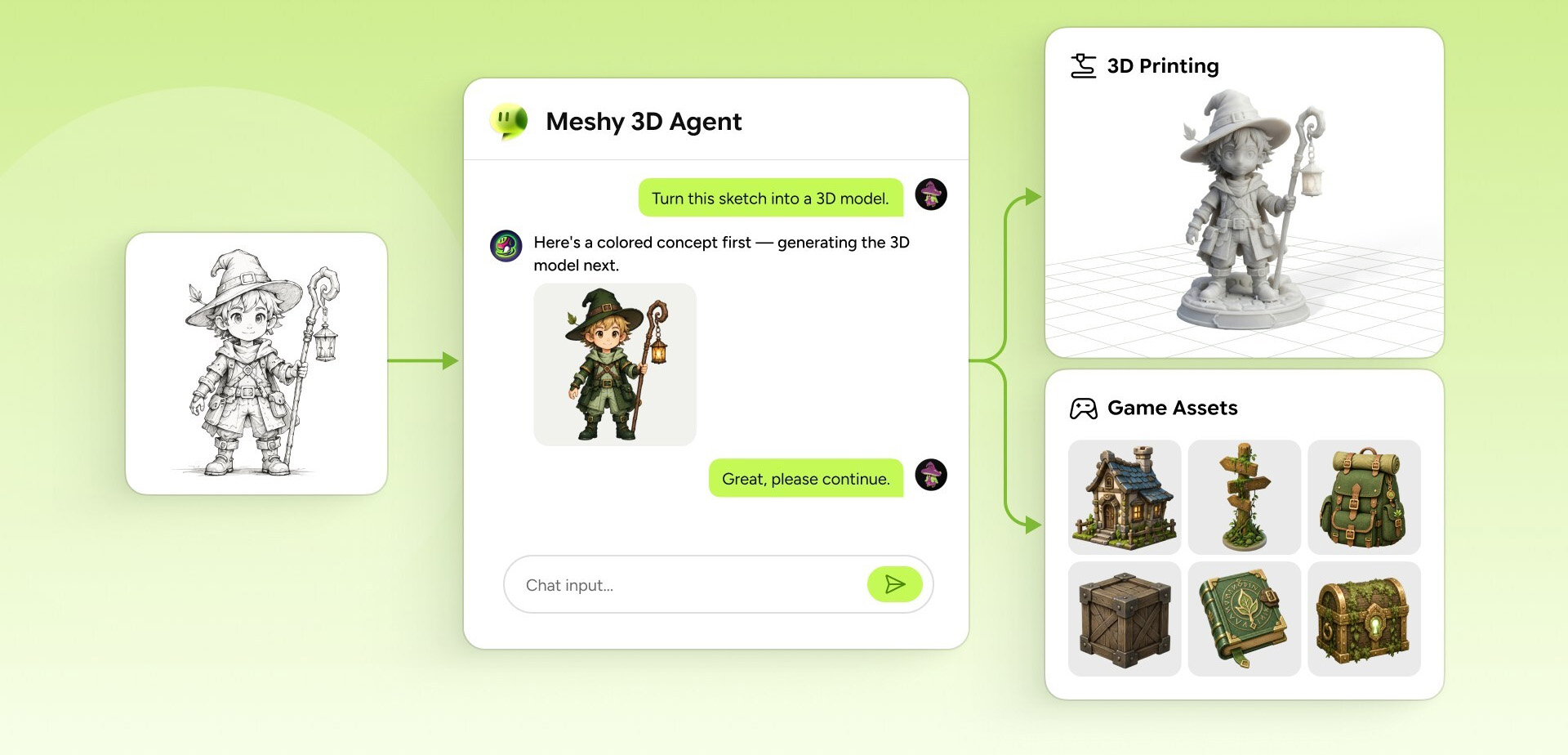
Meshy launches 3D Agent Beta, turning text-to-3D into a multi-stage conversational workflow

Platform
Originally reported by 3Druck
Meshy, a prominent AI-powered 3D model generation platform, has launched its 3D Agent Beta, a new feature that transforms the creation of 3D assets from a single-shot transaction into an iterative, conversational process. Available to all users on meshy.ai since June 4, 2026, the agent allows users to describe an idea in natural language, review the generated result, and then refine details or create variations through targeted adjustments without switching between tools. The service targets use cases in game development, product visualization, concept design, AR/VR, and digital content, with Meshy noting that generated concepts can be transferred into 3D printing workflows, though users must still verify geometry, scale, wall thickness, and slicer settings before printing.
This update marks a significant shift in the AI 3D model generation segment, moving beyond the transactional prompt-and-output model that has defined competitors like Tripo and Hi3D. By introducing a guided, multi-stage workflow, Meshy is addressing a core limitation of current text-to-3D tools: the inability to iteratively refine a model without starting over. The 3D Agent effectively reduces manual intermediate steps, accelerating the journey from early concept to a usable digital asset. For the broader AM software ecosystem, this represents a step toward integrating generative AI more deeply into design workflows, though the agent's actual autonomy remains unclear - Meshy has not specified whether it can directly interface with slicers or CAD tools, leaving the practical depth of its agentic capabilities an open question.
From a practical standpoint, the 3D Agent Beta is a meaningful but incremental improvement to Meshy's existing offering. It does not yet solve the fundamental challenge of generating print-ready geometry from AI output, and users should treat the results as conceptual starting points rather than production-ready files. The real test will be whether Meshy can extend the agent's control to downstream tools like slicers and CAD packages, which would genuinely reduce the manual rework that currently limits AI-generated models in manufacturing contexts. For now, this is a useful productivity enhancement for early-stage ideation, not a replacement for established design and engineering workflows.
This article is an AI-assisted rewrite of the linked source report. Facts originate from the source; phrasing is AMPulse's. Use Read Original below to verify, or Report an issue if something is wrong.