Tuobao Zengcai opens Zhejiang base in Hangzhou, claims 500+ hours continuous stable LPBF printing

Hardware
Originally reported by 南极熊3D打印网
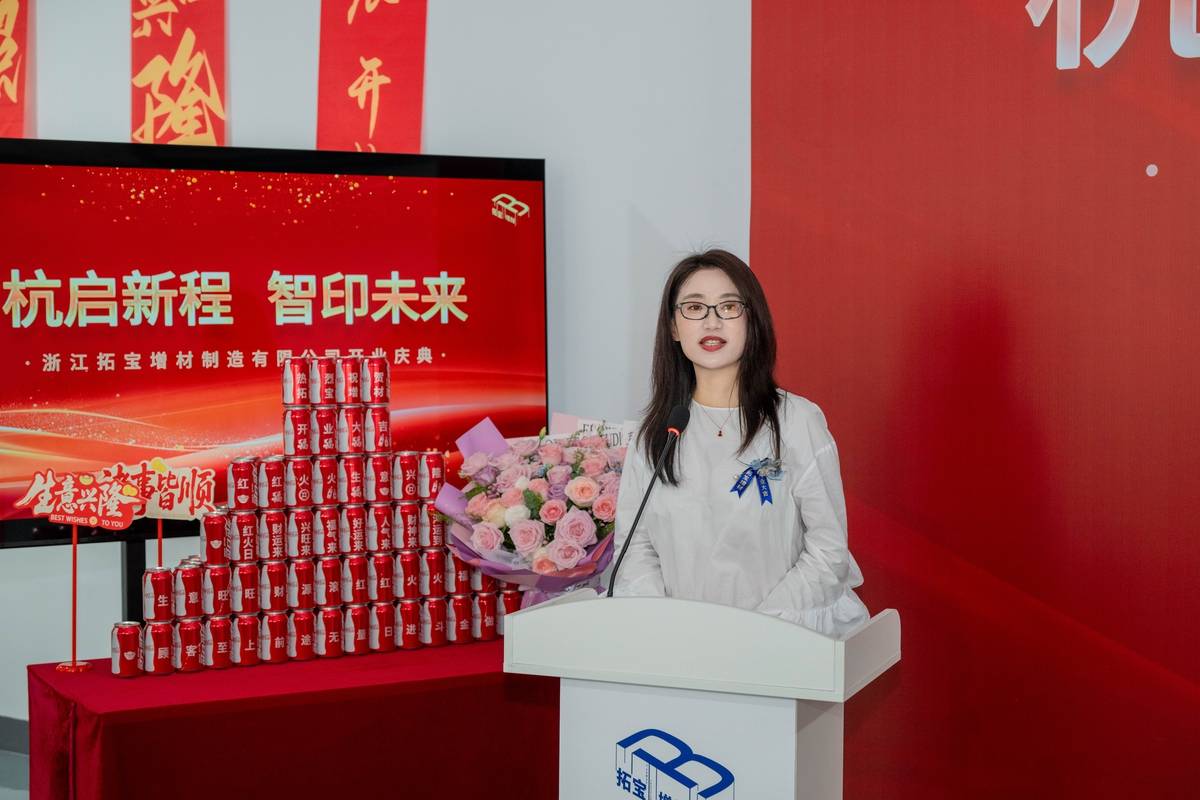
Tuobao Zengcai (拓宝增材) officially opened its Zhejiang manufacturing base on May 20, 2026, in Hangzhou Qingshan Lake Science and Technology City. The facility will serve as the company's regional hub for metal additive manufacturing equipment production and customer support. Chairman Zhang Chenglin stated that the base strengthens Tuobao's presence in the Yangtze River Delta, complementing existing R&D operations in Wuhu, Anhui, and a 100-machine service center in Huai'an, Jiangsu. Tuobao claims its LPBF systems can achieve over 500 hours of continuous stable printing with 100% domestically sourced core components, including lasers, galvanometers, and optical path systems.
This expansion reflects the broader Chinese localization arc in metal AM, where domestic vendors are moving beyond matching Western specifications to building integrated production and service capacity. Tuobao's emphasis on 500-hour continuous run stability directly addresses the industry's persistent gap between single-part qualification and repeatable batch production - a challenge that has limited LPBF adoption in automotive and industrial tooling. The company's 100% domestic supply chain for lasers, optics, and motion systems reduces dependency on Western photonics suppliers, a strategic advantage as US defense procurement becomes more domestically biased under NDAA Section 849. Tuobao's TB-700, an 8-laser large-format system with 720mm build capability, positions it against Chinese peers like BLT and Farsoon in the growing domestic market for production-scale metal AM.
Tuobao must now demonstrate that its 500-hour stability claim holds across multiple machines and customer sites, not just in controlled demo conditions. The company's Huai'an service center, with 20 machines already installed and a target of 100 units, will be the real test bed for repeatability and yield at scale. For buyers evaluating Chinese LPBF systems, the relevant comparison is no longer just machine specs but the maturity of the service ecosystem and qualification support that comes with them.
This article is an AI-assisted rewrite of the linked source report. Facts originate from the source; phrasing is AMPulse's. Use Read Original below to verify, or Report an issue if something is wrong.
Topics