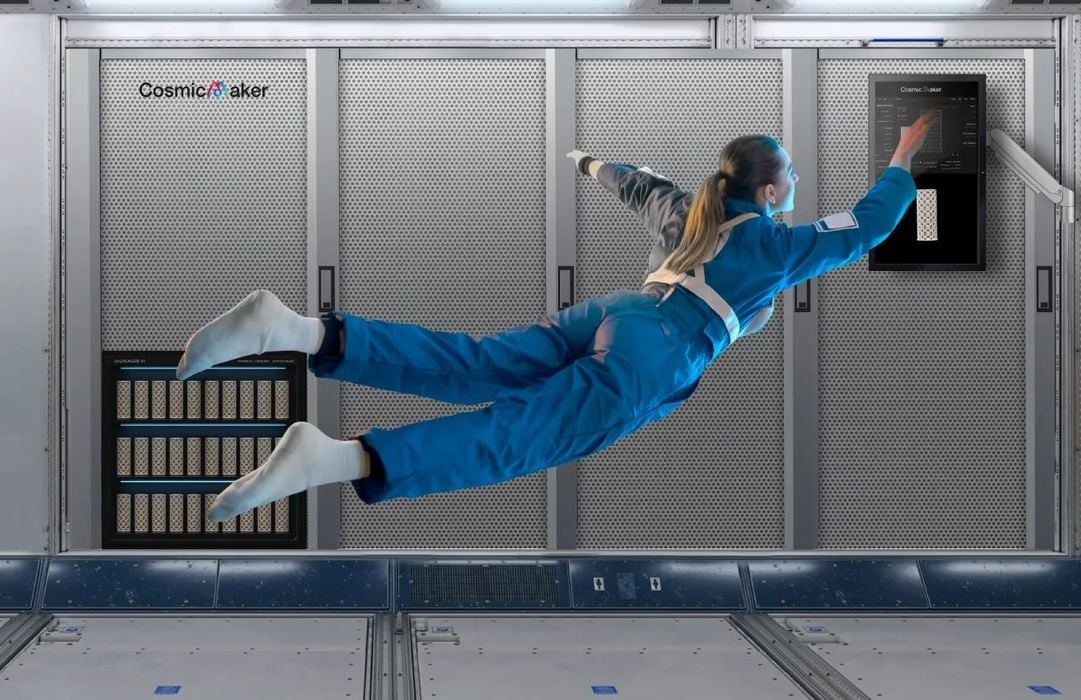
Photocentric advances CosmicMaker project targeting autonomous 3D printing for space manufacturing

Hardware
Originally reported by Fabbaloo
Photocentric, the UK-based resin and printer manufacturer, has provided an update on its CosmicMaker project, a fully autonomous 3D printing platform designed for in-orbit manufacturing. The system, developed in partnership with Deployables Cubed and supported by the Business in Space Growth Network’s In-orbit Manufacturing Accelerator (IMA), has completed a prototype phase (CosmicMaker I) that successfully printed polymers and ceramics under simulated microgravity. The current roadmap targets a flight-ready CosmicMaker II system by 2026, with autonomous operation on parabolic flights scheduled for April 2026, followed by an ISS-ready CosmicMaker III in 2027 and a multi-material, metal-capable CosmicMaker IV by 2030. Photocentric is positioning the platform to capture a share of a forecasted $17 billion space additive manufacturing market.
This project extends Photocentric’s core competency in resin-based photopolymerization into an extreme-environment application where orientation-agnostic printing and low energy consumption are critical. The space manufacturing segment remains nascent but is accelerating due to declining launch costs from SpaceX and Blue Origin, which are themselves heavy AM users. CosmicMaker competes indirectly with other in-space manufacturing concepts from Made In Space (now part of Redwire) and Tethers Unlimited, but Photocentric’s resin-based approach is distinct from the FFF/FFF-based systems typically proposed for microgravity. The company’s ability to demonstrate ceramic printing under microgravity is notable, as ceramics offer thermal and structural properties relevant to satellite components and re-entry shielding. However, the gap between simulated microgravity and a qualified, flight-ready system remains wide, and the 2030 metal-capable target implies a multi-year qualification cycle that will require significant capital and partnership support.
For Photocentric, the practical next step is securing a path to actual microgravity testing - either via ISS payload slot or a dedicated suborbital flight - to validate the system’s reliability beyond parabolic simulation. The company must also demonstrate that its resin chemistry and curing mechanism remain stable under launch vibration and vacuum conditions. For the broader AM industry, CosmicMaker is a reminder that space manufacturing remains a long-duration bet where technical feasibility has been shown but commercial viability and qualification infrastructure are still being built. Readers should treat the $17 billion market figure as a speculative total addressable projection, not a near-term revenue opportunity.
Topics