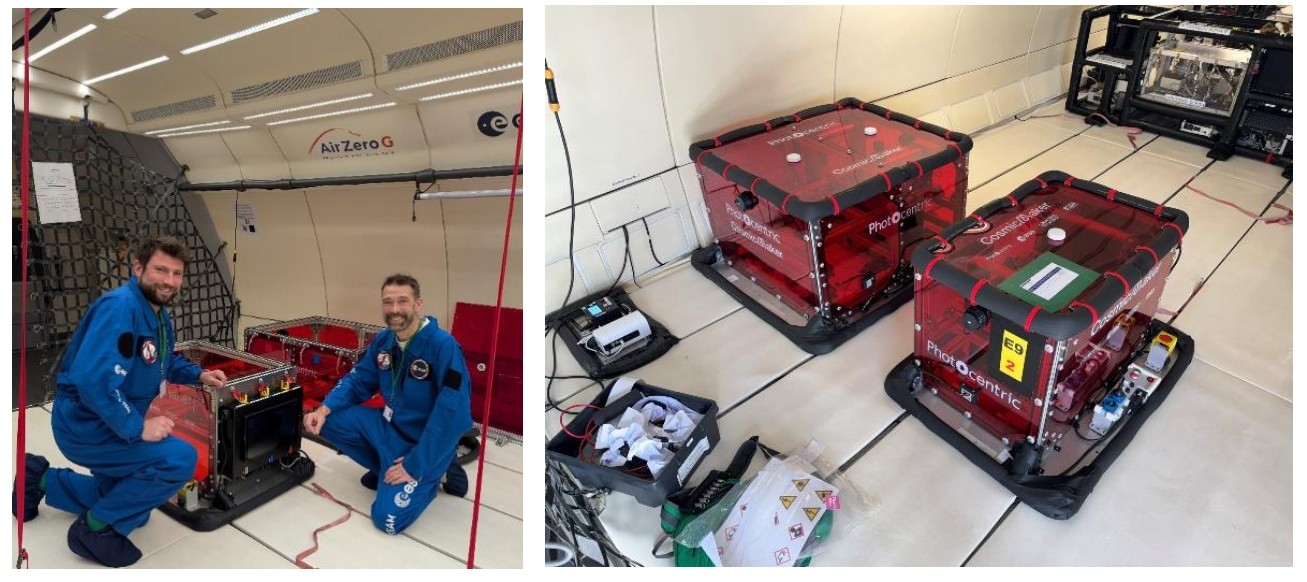
Photocentric spins out CosmicMaker for zero-gravity LCD 3D printing after parabolic flight success

Hardware
Originally reported by 3D ADEPT
Photocentric has spun out its space-oriented 3D printing technology into a new standalone business, CosmicMaker Ltd., following successful parabolic flight tests in April 2026. Three identical enclosed-chamber LCD printers flew aboard Novespace's Airbus A310 Zero G out of Bordeaux across three flights between April 22 and 24, operating continuously through the full 2g-to-0g range. The company, which commercialized the first LCD-driven 3D printer in 2014 and patented a space-ready enclosed-chamber LCD process in 2020, has received three grants from the UK Space Agency via ESA's BSGN program to manufacture and validate the system. CosmicMaker will now operate as an independent entity focused on in-space manufacturing, with Photocentric's CTO Sam Bernard and 3D Applications Manager Nikita Chibisov involved in the spin-out.
This move places CosmicMaker in a narrow but strategically important niche within the broader AM industry: polymer vat photopolymerization adapted for microgravity. The core technical claim - that the machine operates better in space than on earth - hinges on the LCD screen's ability to function without the convection-driven resin dynamics that complicate terrestrial DLP/SLA systems. This positions CosmicMaker against a small set of competitors pursuing in-space AM, including Made In Space (now part of Redwire) with its FFF-based systems and the European Space Agency's ongoing experiments with various polymer processes. The UK Space Agency's backing through ESA's BSGN program provides both funding credibility and a pathway toward qualification for actual orbital missions, though the gap between parabolic flight validation and sustained orbital operation remains significant. The spin-out structure allows Photocentric to isolate the high-risk, long-cycle space business from its core terrestrial LCD printer operations, a sensible value-chain separation that avoids diluting the parent company's focus on the more immediate industrial and dental markets.
For CosmicMaker, the immediate next step is securing a path from parabolic flight to an actual orbital demonstration, likely through a rideshare or ISS experiment slot. The company must demonstrate that the enclosed-chamber LCD process can survive launch vibration, maintain print quality over extended microgravity periods, and handle the thermal vacuum environment of orbit. The UK Space Agency's continued support suggests a realistic timeline of 18-24 months before an orbital test, assuming no major technical surprises emerge from the parabolic data. For the broader AM industry, this remains a long-duration bet on in-space manufacturing demand, not a near-term commercial opportunity.
This article is an AI-assisted rewrite of the linked source report. Facts originate from the source; phrasing is AMPulse's. Use Read Original below to verify, or Report an issue if something is wrong.
Topics