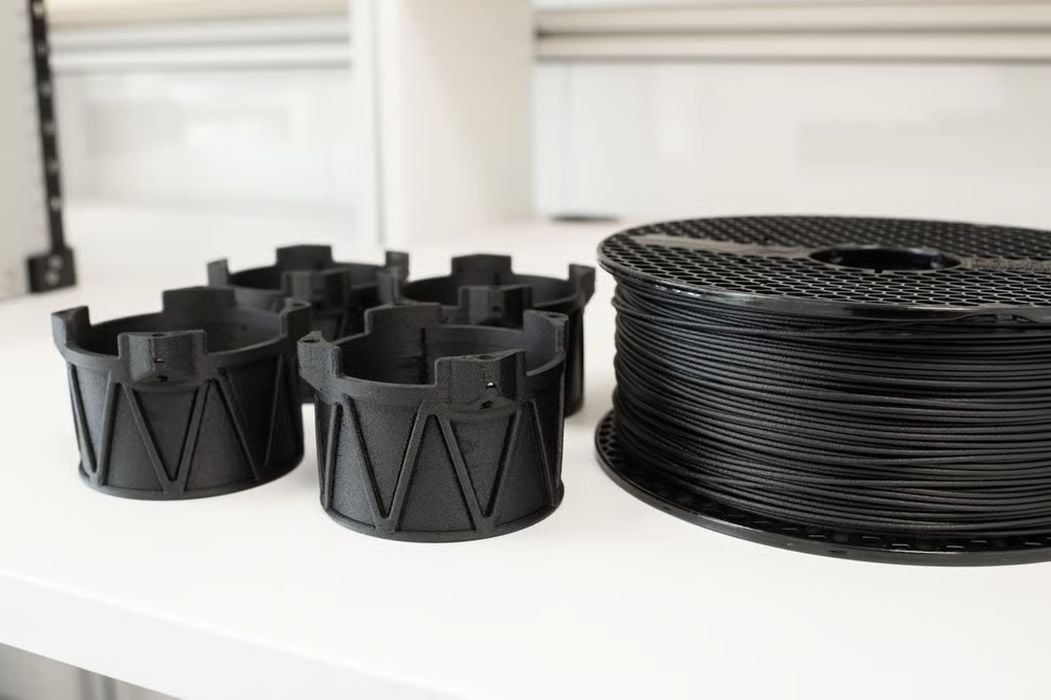
Prusa Research launches Prusament PC Space Grade Black filament for aerospace-grade desktop FFF printing.

Hardware
Originally reported by Fabbaloo
Prusa Research, the Czech desktop 3D printing hardware and materials leader, has released a new specialty filament, Prusament PC Space Grade Black. Developed in a joint project with Czech satellite integrator TRL Space, the material is a polycarbonate (PC) variant enhanced with unspecified carbon additives to meet stringent aerospace environmental requirements. It is engineered to provide exceptional electrostatic discharge (ESD) safety and extremely low outgassing, critical properties for electronics housings and sensor components in vacuum and enclosed spacecraft environments. The filament is priced at $250 per 850g spool ($295/kg) and is designed to be processed on common desktop FFF printers using standard PC parameters.
This move represents a calculated expansion from Prusa's dominant position in the desktop/prosumer polymer extrusion segment into a high-value, qualification-sensitive vertical. While the aerospace qualification grind is famously long and costly for metal additive manufacturing, the demand for qualified, accessible materials for secondary, non-critical components-particularly in the burgeoning small satellite and CubeSat sector-creates a niche. Prusa is leveraging its established brand trust and material science capabilities to address this need, effectively creating a bridge between the economically important but media-invisible industrial tooling segment and the low-volume, high-reliability demands of aerospace research and prototyping. The development also fits the pattern of a hardware OEM deepening its value-chain capture through specialized, application-locked materials, a strategy that builds moats beyond machine sales.
The expert take is that this is a smart, incremental product development that aligns with real, though narrow, market demand. For satellite integrators and aerospace research teams, it offers a cost-effective, accessible material option with documented properties for prototyping and non-structural parts. Prusa's next practical step must be to build a library of certified test data and, potentially, pursue formal material qualifications with agencies to transition from a 'space-ready' marketing claim to a 'space-qualified' supply chain option. For the broader market, it underscores that material governance and application-specific formulations are becoming key competitive axes even in the desktop FFF segment.
Topics