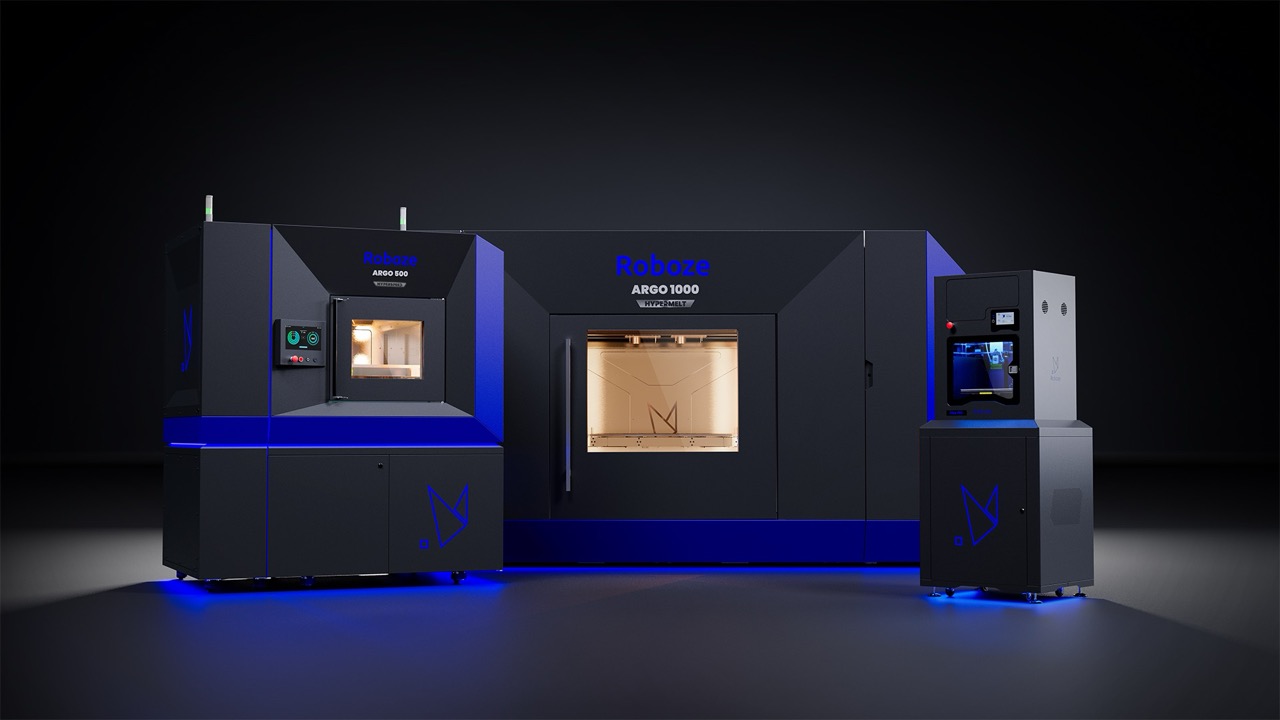
ROBOZE and SUPSI partner to develop 3D-printed carbon-carbon and ceramic matrix composites for extreme-temperature applications

Hardware
Originally reported by 3Druck
ROBOZE, the Italian industrial polymer extrusion specialist, has launched a joint research initiative with the University of Applied Sciences and Arts of Southern Switzerland (SUPSI) to develop additively manufactured carbon-carbon (C-C) and ceramic matrix composite (CMC) components. The collaboration, involving SUPSI's Institute of Mechanical Engineering and Materials Technology (MEMTi), aims to combine ROBOZE's high-temperature FFF printing platforms with SUPSI's expertise in thermal conversion processes and materials characterization. The goal is to produce parts whose geometry, microstructure, and properties are tailored for extreme thermal and mechanical environments, moving beyond 3D printing as a mere shaping technique to a process chain that includes post-print material transformation. Simone Cuscito, Chief R&D and Product Officer at ROBOZE, framed the work as enabling a new generation of additively manufactured C-C and CMC materials for conditions ranging from ultra-high temperatures to aggressive industrial settings.
This partnership targets a frontier where polymer AM has historically struggled: producing structural components that survive beyond the thermal limits of even high-performance thermoplastics like PEEK and PEKK. C-C and CMC materials are valued in aerospace, energy systems, hypersonics, and future fusion reactors for their thermal shock resistance, oxidation stability, and mechanical integrity at temperatures where metal alloys fail. The approach is notable because it treats the 3D-printed polymer preform as an intermediate, not the final part, with subsequent thermal conversion yielding the ceramic or carbon-carbon matrix. This mirrors the logic of preceramic polymer routes but applied to complex geometries enabled by FFF. The key editorial question is whether ROBOZE and SUPSI can move from laboratory demonstrations to reproducible, qualified part routes - a challenge that has historically kept CMC additive manufacturing in the research domain rather than production.
From a practical standpoint, this project is early-stage research, not a commercial product announcement. The critical execution milestones will be demonstrating repeatable material properties, dimensional stability through the conversion process, and a cost structure that competes with conventional CMC forming methods like chemical vapor infiltration or slurry casting. For ROBOZE, the initiative extends its value proposition beyond printing hardware into materials science and process chain engineering, which could differentiate it in the high-temperature industrial segment. For the broader AM industry, the work is a reminder that the most demanding applications often require rethinking the entire process chain, not just the printing step.
This article is an AI-assisted rewrite of the linked source report. Facts originate from the source; phrasing is AMPulse's. Use Read Original below to verify, or Report an issue if something is wrong.
Topics