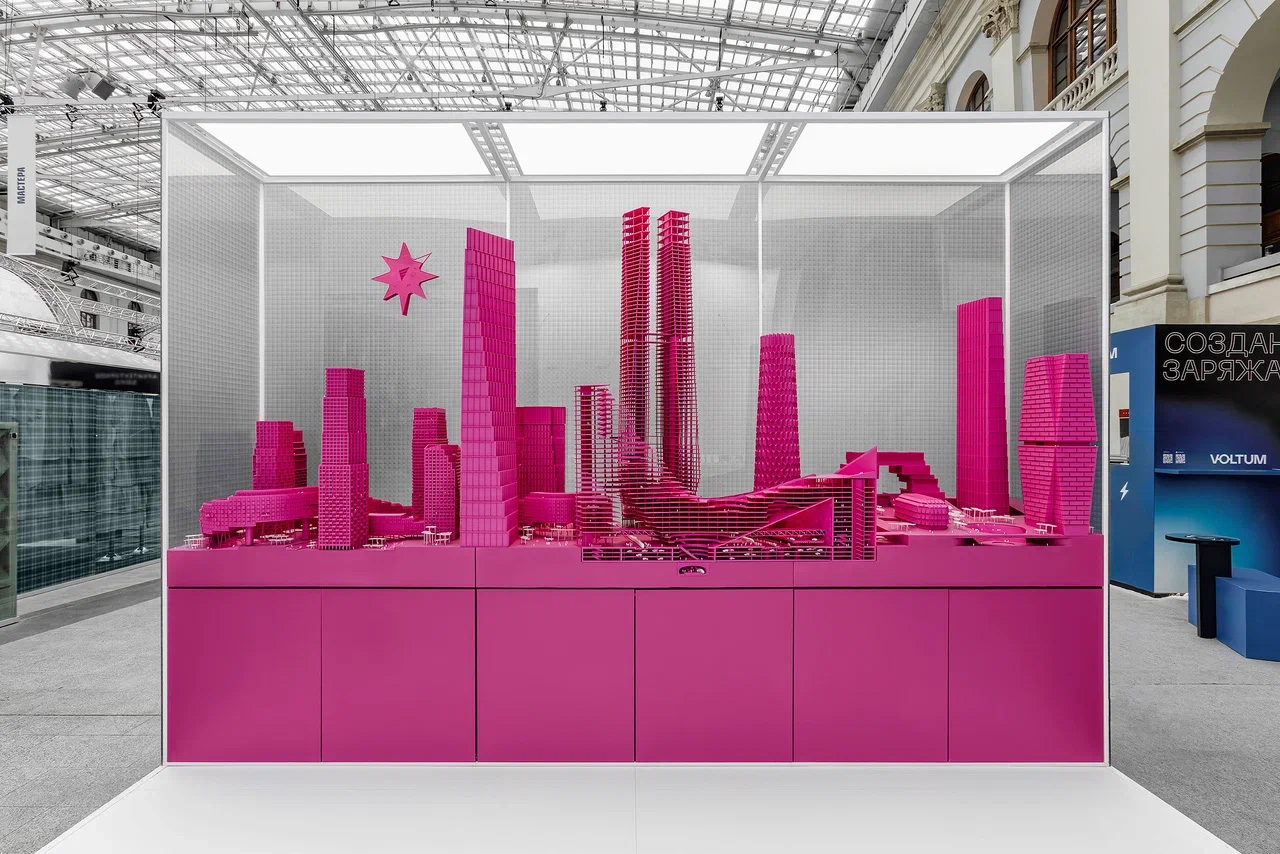
Russian architecture firm MAM 3D prints 4-meter city model from 20 kilometers of filament for ARCH MOSCOW exhibition
Originally reported by 3Druck
Russian architecture studio MAM has produced a monumental 4-meter-tall city model for the ARCH MOSCOW trade fair at Gostiny Dvor, consuming 20 kilometers (60 kg) of pink filament. The project, titled 'City Fata Morgana,' required MAM to scale its printer fleet from three to eight FDM/FFF machines and complete all printing within one month. The model incorporates over 200 figures, 100 trees, 20 Lamborghinis, 20 police cars, 17 buildings, and 7 cats, drawn from real projects including the Light City business district currently under construction and several competition designs like the Lomonosov cluster and a Tretyakov Gallery branch in Kommunarka. Translucent walls separate the dense urban structure from the exhibition space, with L1GROUP providing lighting to create a mirage-like effect aligned with the 'Ideal' seasonal theme.
This project sits firmly within the polymer material extrusion (polymer-mex) segment, showcasing a pure application-layer use case rather than a technology breakthrough. The significance lies not in the process-desktop FDM/FFF printing at this scale is well-established-but in the architectural visualization vertical. MAM's decision to expand from three to eight printers for a single project demonstrates how service bureaus and architectural firms are increasingly treating 3D printing as a production tool for large-scale presentation models, moving beyond smaller prototypes. The material consumption of 20 kilometers of filament and 60 kg of polymer underscores the logistical demands of scaling FDM/FFF for exhibition-grade pieces, though the economics remain niche: this is a commissioned artwork, not a serial production application.
From a practical standpoint, this is a well-executed exhibit piece that does not signal a shift in AM economics or technology. MAM validated its ability to ramp print capacity for a specific event, but the model's cost and material consumption are irrelevant to industrial production metrics. For buyers in architecture and exhibition design, the takeaway is that large-format FDM/FFF can deliver visually striking results with sufficient planning, but the one-off nature of such projects means unit economics are secondary to the spectacle value. MAM's success here is about project management and aesthetic ambition, not technological disruption.
This article is an AI-assisted rewrite of the linked source report. Facts originate from the source; phrasing is AMPulse's. Use Read Original below to verify, or Report an issue if something is wrong.