Spherene AG joins 3MF Consortium to advance Adaptive Density Minimal Surfaces standard for 3D printing

Software
Originally reported by 3Druck
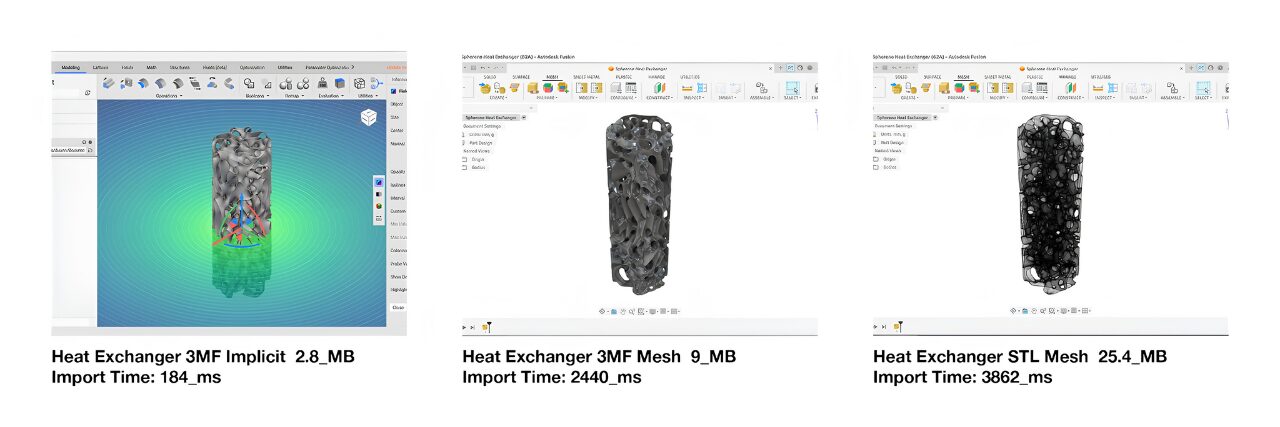
Spherene AG, a Swiss software company specializing in Adaptive Density Minimal Surfaces (ADMS), has joined the 3MF Consortium to contribute its patented geometry engine to the development of the open 3MF file format. The company aims to solve a critical data-loss problem in additive manufacturing: functional internal geometries, density gradients, and metamaterial structures designed in CAD are often degraded or lost when transferred through the production chain. Spherene reports that for a complex ADMS model, file size drops from 24 MB in mesh-based 3MF to 9 MB, and the new 3MF Volumetric Extension can represent the same structure implicitly in just 2.8 MB without dense mesh breakdown. CEO Claudio Nessi stated that open, interoperable standards are essential for unlocking AM's full potential, while 3MF Executive Director Duann Scott noted that existing formats cannot adequately represent volumetric and implicit geometry.
This move addresses a persistent bottleneck in industrial AM: the gap between advanced design capability and production fidelity. As internal geometries become functional elements in aerospace, medical, automotive, and energy parts, the inability to preserve volumetric information through the file format undermines the value of sophisticated design tools. Spherene's ADMS technology, which generates continuously adjustable cell sizes and material densities along complex 3D surfaces, has been limited by formats like STL that describe only surfaces. By embedding its approach into the 3MF standard, Spherene is working to make implicit geometry a native, lossless part of the AM workflow. This aligns with the broader industry shift from geometry-centric to function-centric part definition, where material properties and internal structure are as important as outer shape.
For Spherene, joining the consortium is a practical step to ensure its technology becomes infrastructure rather than a proprietary island. The company is also developing a next-generation platform that more tightly integrates design, simulation, and functional requirements at the volumetric level. The real test will be adoption: whether machine OEMs and software vendors implement the volumetric extension broadly enough to make the standard meaningful in production environments. For now, this is a standards play that could reduce file bloat and improve data integrity for complex lattice and metamaterial parts, but its impact depends on ecosystem uptake.
This article is an AI-assisted rewrite of the linked source report. Facts originate from the source; phrasing is AMPulse's. Use Read Original below to verify, or Report an issue if something is wrong.
Topics