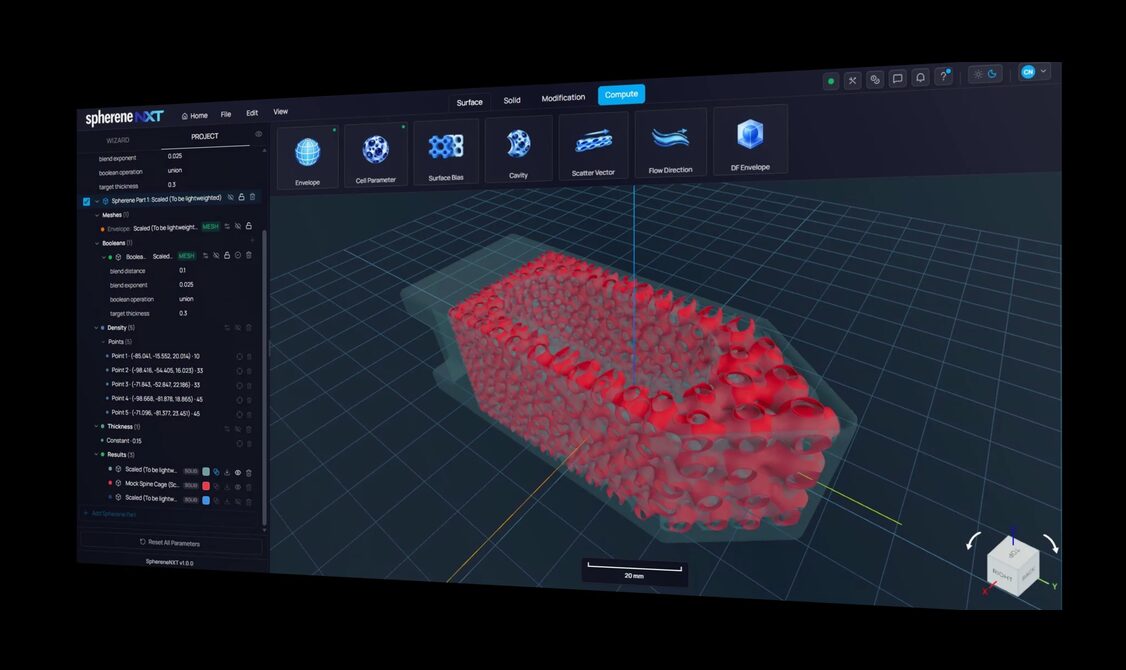
Spherene launches SphereneNXT browser-based platform for adaptive metamaterial structures

Software
Originally reported by 3Druck
Swiss software company Spherene has launched SphereneNXT, a browser-based platform for designing internal structures in 3D-printed components. The platform enables engineers to generate, optimize, and export complex infill geometries as printable data without requiring additional desktop CAD software. At its core is Spherene's Adaptive Density Minimal Surface (ADMS) technology, which replaces uniform fill patterns and traditional lattice structures with continuously adapted minimal surfaces. Density, cell size, wall thickness, and orientation adjust dynamically based on loads, component geometry, scale, and boundary conditions, concentrating material in highly stressed areas while reducing it elsewhere. The platform also supports TPMS (triply periodic minimal surface) structures, but distinguishes itself through ADMS's aperiodic, shape-adaptive approach versus TPMS's periodic unit cells.
This launch addresses a persistent gap in the AM software value chain: the ability to generate production-ready, load-adaptive infill geometries without forcing users to abandon their existing CAD environment. Most current infill generation tools remain either simplistic (uniform grids) or require dedicated simulation and optimization software that adds workflow friction. SphereneNXT operates as a standalone browser application that accepts CAD or mesh files, including multi-part assemblies, and exports directly to printable formats. For process segments like polymer SLS, MJF, and FDM/FFF, where weight reduction and stiffness tuning are critical for end-use parts, this approach could lower the barrier to adopting functionally graded metamaterials. The platform's independence from any specific CAD system positions it as a complementary tool rather than a replacement, which may accelerate adoption in engineering teams already locked into established workflows.
From a practical standpoint, SphereneNXT's value hinges on whether its ADMS structures can be reliably printed across multiple material and process combinations without requiring extensive per-part calibration. The platform includes tools for improving printability and a meshing algorithm to generate compact, error-free mesh files, which addresses a common failure point in complex lattice design. Engineers evaluating this tool should test it against their specific load cases and printer capabilities, particularly for metal PBF-LB applications where support structure removal and thermal management remain non-trivial. The browser-based delivery model reduces IT overhead, but the real test will be whether the generated structures consistently outperform conventional infill in mechanical testing at production scale.