Stick Tech patent targets automated part removal via controlled elastomer sheet bending

Materials
Originally reported by Fabbaloo
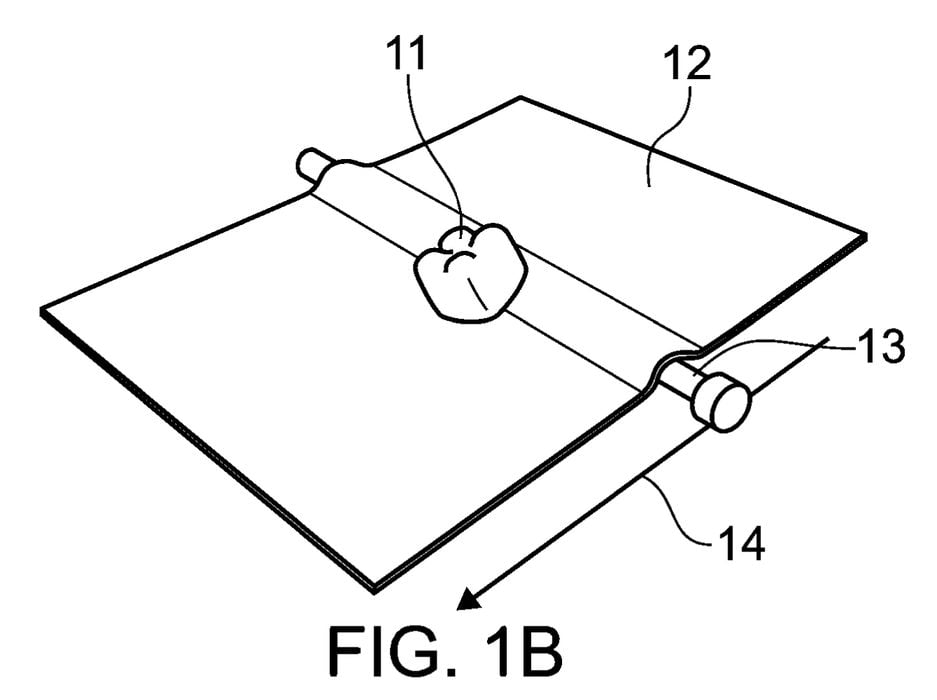
Stick Tech Oy, a small Finnish startup, has published European patent application EP-4741139-A1 titled “Method for Printing and Printer,” detailing a method for automated part removal from a build surface. The patent describes printing onto a removable elastomer sheet that can be bent with an inner bend radius of 50 to 800 percent of sheet thickness (per ISO 10619-1:2018, method B), causing the printed object to detach through controlled flexure. The application includes a mechanism where a “stick” slides under the sheet to induce the bend, suggesting the company is targeting integration into a continuous printing workflow rather than a standalone consumable. Stick Tech has a registered domain but no public website, indicating it is likely a pre-revenue startup seeking to license or develop the concept further.
This patent addresses a persistent bottleneck in production-oriented polymer AM: part removal. In FFF/FFF, resin, and paste-based systems, the removal step often limits throughput because it requires manual scraping, prying, or post-processing. If Stick Tech can demonstrate that an elastomer sheet survives hundreds of cycles, maintains dimensional stability during printing, and works across materials such as PA12, TPU, or photopolymers, the method could reduce operator labor and enable automated post-build ejection. The approach competes with existing solutions like spring steel PEI plates, magnetic build sheets, and freezer tricks, but differs by making the sheet’s bending behavior a controlled, repeatable part of the machine architecture. The patent’s scope - covering both method and printer - suggests Stick Tech is not merely claiming a consumable but a system-level integration, potentially targeting service bureaus or high-throughput desktop farms where removal time is a hidden cost.
From a practical standpoint, this is a patent application, not a product. Stick Tech must now demonstrate that the elastomer sheet can survive repeated bending without fatigue, maintain first-layer accuracy, and handle the thermal and chemical demands of common AM materials. If the company can validate these properties and license the method to established printer OEMs, it could become a useful incremental improvement for automated production. For now, the industry should treat this as an interesting mechanical concept that requires significant engineering validation before it reaches commercial relevance.
Topics