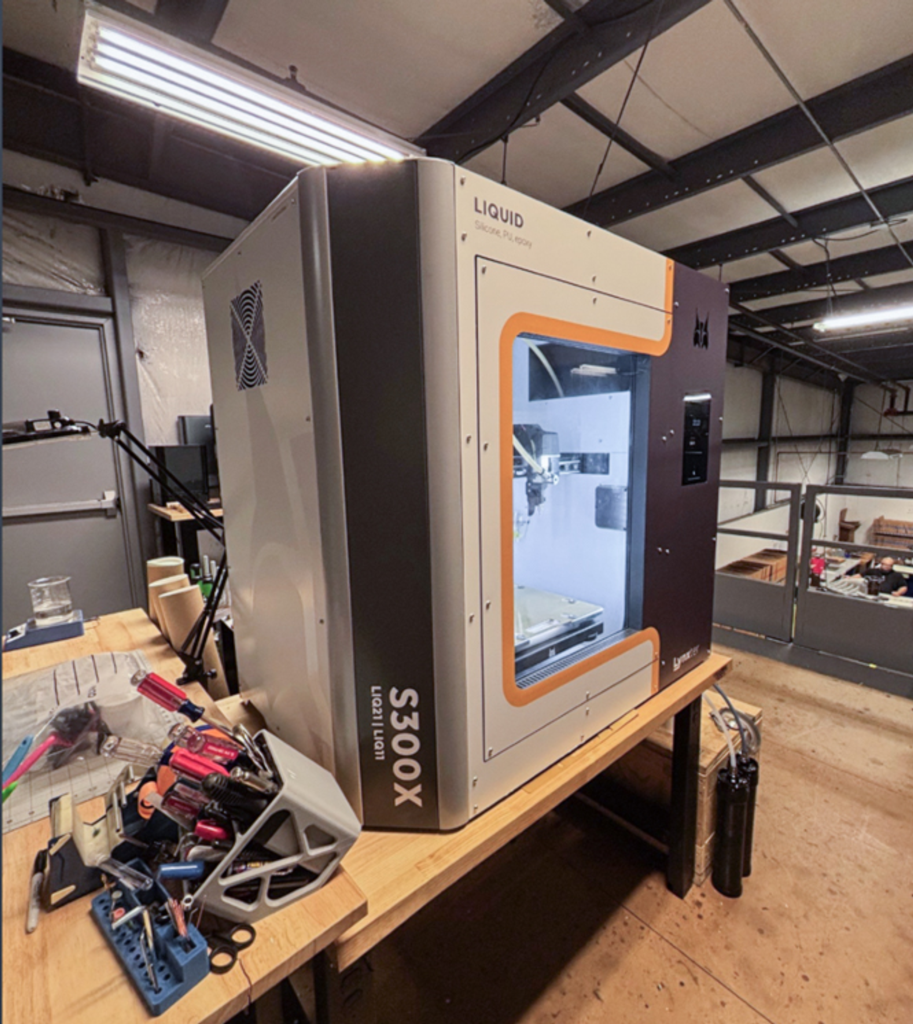
Stockwell Elastomerics integrates Lynxter S300X silicone 3D printer to cut prototype validation from weeks to days

Application
Originally reported by 3D Printing Industry
Stockwell Elastomerics, a Philadelphia-based silicone manufacturer with over a century of molding and converting experience, has integrated the Lynxter S300X LIQ21|LIQ11 platform into its operations. The system prints with actual liquid silicone rubber (LSR) formulations ranging from 5 to 70 Shore A hardness, the same materials used in Stockwell's Liquid Injection Molding (LIM) production lines. By adopting this material extrusion (MEX) approach for elastomers, Stockwell has reduced customer prototype validation timelines from weeks to days, delivering multiple functional iterations within a single week and eliminating the material compromises inherent in resin-based alternatives like SLA or DLP.
This adoption addresses a persistent gap in the AM industry: the inability to produce functional elastomeric prototypes that replicate the mechanical behavior of production-grade silicone. Resin-based alternatives cannot reproduce compression set, elongation, or sealing behavior under industrial conditions, forcing manufacturers to wait for molded samples before meaningful validation. Stockwell's integration of the Lynxter platform closes that loop, allowing customers to compress, assemble, and test sealing behavior on parts that perform like final products before committing to production tooling. This positions Stockwell as a service-led bridge between prototyping and production, a value-chain role that is increasingly critical as industrial end-users demand faster design cycles without sacrificing material fidelity.
For the broader AM market, this is a practical step forward in elastomer printing, not a breakthrough. The Lynxter S300X has been commercially available since 2021, and Stockwell's move is a validation of its reliability for production-adjacent workflows. The real test will be whether Stockwell can scale this capability beyond prototype runs into low-volume production, and whether the Lynxter platform can maintain throughput and repeatability under sustained use. For buyers evaluating silicone AM, the key takeaway is that functional validation is now achievable without tooling, but the economics of serial production remain unproven.