VF Space raises Pre-A funding to commercialize WLAM metal 3D printing for shipbuilding, aerospace, and defense

Hardware
Originally reported by Platum
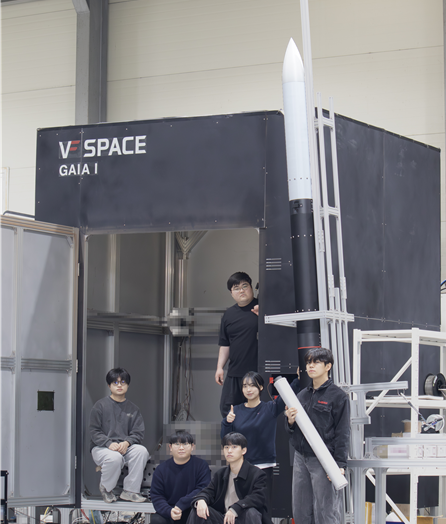
South Korean deep-tech startup VF Space has closed a Pre-A funding round, with participation from MYSC and Harang Technology Investment, the operator of the New Space Fund. The company is developing metal 3D printing equipment based on its proprietary Wire Laser Additive Manufacturing (WLAM) technology, which uses metal wire fed through a laser-heated nozzle to build parts layer by layer. VF Space’s core differentiator is its in-house developed laser head, Medusa, which delivers up to 6 kW of laser power and achieves deposition rates of 3–5 kg per hour. The company’s large-format printer, GAIA I, is already offering metal AM services, and it plans to launch a smaller system, GAIA N, alongside the Medusa laser head in the second half of 2026.
This funding round places VF Space within the growing metal DED/WLAM segment, which is gaining traction for large-scale, high-deposition-rate applications where powder-bed processes like LPBF are too slow or expensive. The company’s target verticals - shipbuilding, aerospace, energy, and defense - are exactly the sectors where wire-based DED offers a compelling value proposition: lower material cost, higher build rates, and the ability to produce meter-scale parts. VF Space has already completed a plasma thruster demonstrator and fabricated a satellite structural component (a kill switch) that is slated for space environment validation on the fifth launch of Korea’s Nuri rocket. The company is also developing a hybrid rocket engine and a sounding rocket called Hyperion Junior, with launch contracts secured. This dual focus on both equipment sales and in-house mission services mirrors the pattern seen in other DED startups that use service revenue to fund hardware maturation.
VF Space’s immediate challenge is moving from demonstrators and service contracts to repeatable, qualified production for defense and aerospace customers. The company’s plan to relocate its space systems facility to Goheung County, home to Korea’s space launch cluster, is a practical step toward integrating with the national space supply chain. For buyers evaluating DED for large structural parts, the key question is whether VF Space can deliver consistent mechanical properties and certification-ready process documentation - not just impressive deposition rates. The Medusa laser head’s 6 kW output and 3–5 kg/hr deposition rate are competitive with established DED systems from companies like Meltio and WAAM3D, but the company must now prove it can turn those specs into production-grade reliability.
Topics