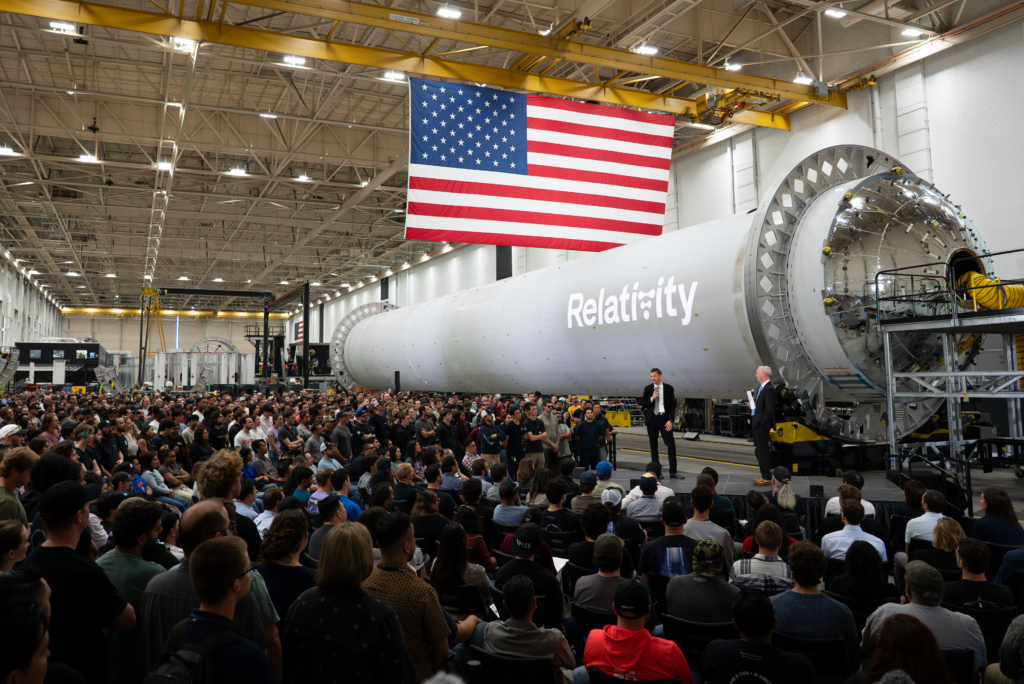
NASA selects Relativity Space for 2028 Mars science mission with Aeolus payload

Hardware
Originally reported by 3DPrint.com
NASA has selected Relativity Space as its commercial partner for a Mars science mission launching in 2028, awarding a six-year Space Act Agreement under which Relativity will supply the spacecraft, launch vehicle, and mission operations. The mission will carry NASA's Aeolus payload — four instruments developed by NASA Ames Research Center to study Martian winds, temperatures, dust, and clouds — on Relativity's Terran R rocket. NASA Administrator Jared Isaacman framed the partnership as a force multiplier, pairing NASA instruments with commercial investment. The atmospheric data is intended to improve entry, descent, and landing models for future robotic and human missions.
This selection marks a significant vote of confidence for Relativity Space, a company whose trajectory has been closely watched since its Terran 1 rocket — the first largely 3D-printed rocket to reach space — failed to achieve orbit in its sole 2023 launch attempt. Relativity subsequently retired Terran 1 and pivoted entirely to Terran R, a much larger reusable rocket still under development. For the additive manufacturing industry, the announcement validates large-scale metal directed energy deposition (DED) — the Stargate printing system — as production infrastructure for spaceflight hardware, not just prototyping. It also fits the pattern of AM success becoming invisible as it matures: Relativity's 3D printing capability is now treated as standard manufacturing infrastructure rather than a novelty, which paradoxically signals deeper credibility. The partnership sidesteps the question of whether Relativity can win commercial launch contracts at scale; instead, it locks in government-funded payload integration, giving the company a funded development pathway through 2028.
Practically, Relativity must now execute on the Terran R development timeline and demonstrate the vehicle's reliability for a deep-space mission. NASA's willingness to bet a Mars payload on a company that has yet to fly a fully successful orbital launch is unusual and imposes considerable delivery risk. For buyers and investors, the key metric is not marketing language but whether Terran R completes its first test flight and meets the Mars 2028 integration deadlines. This is a high-stakes program that will demand disciplined engineering execution, not just additive manufacturing capability.
This article is an AI-assisted rewrite of the linked source report. Facts originate from the source; phrasing is AMPulse's. Use Read Original below to verify, or Report an issue if something is wrong.
Topics