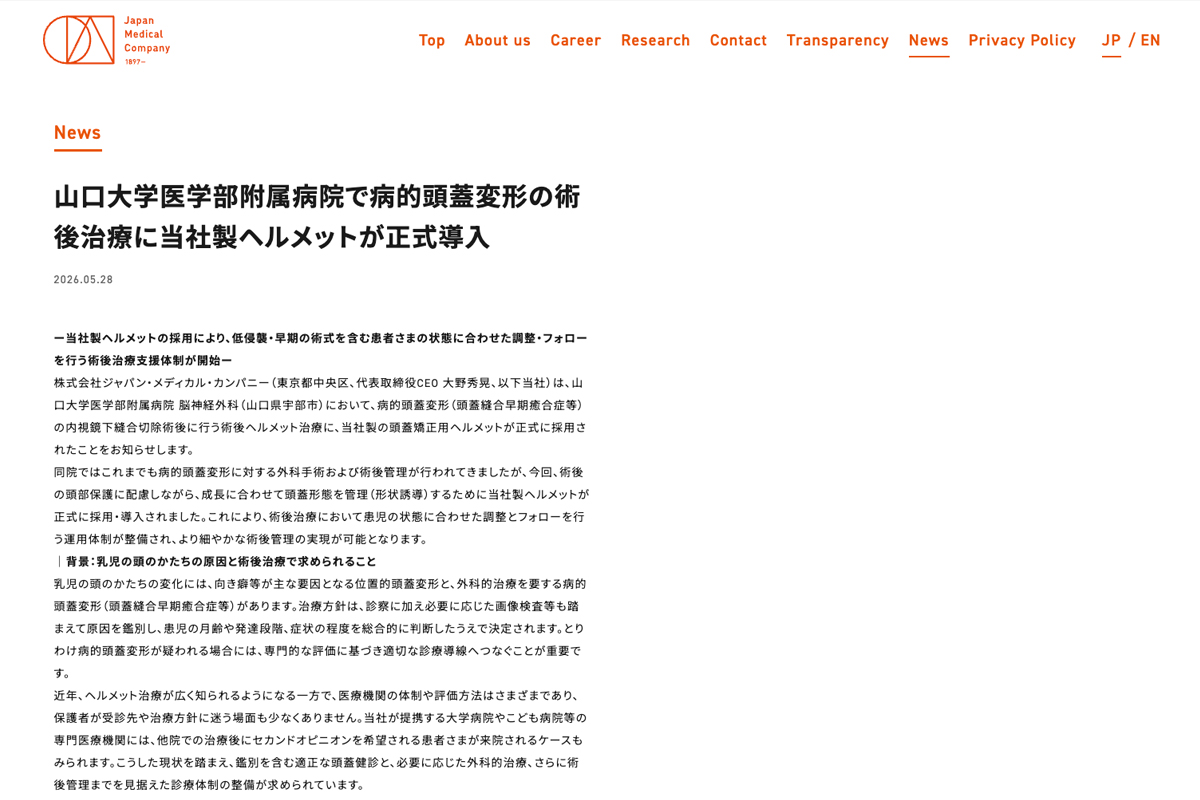
Yamaguchi University Hospital adopts Japan Medical Company's custom 3D-printed helmet for post-surgical cranial deformity treatment

Hardware
Originally reported by ShareLab
Yamaguchi University Hospital, a 754-bed advanced treatment center in Japan, has formally adopted a custom 3D-printed cranial orthosis from Japan Medical Company for postoperative management of pathological cranial deformities such as craniosynostosis. The helmet is designed using 3D scan data of each infant's skull and is intended to protect the surgical site while guiding skull shape during growth. The hospital's neurosurgery team, including Dr. Sadahiro Nomura and Dr. Natsumi Fujii, are certified in helmet therapy evaluation, ensuring proper differential diagnosis between positional and pathological deformities. This marks a clinical adoption of a digitally manufactured, patient-specific medical device within a major academic medical center.
This deployment is a concrete example of how 3D scanning and custom fabrication are moving beyond prosthetics and dental into pediatric neurosurgery, a niche but clinically demanding vertical. For Japan Medical Company, the partnership validates its ability to integrate into a hospital's postoperative protocol, not just supply a device. The company gains a reference site at a university hospital that can generate clinical evidence and peer-reviewed outcomes, which is essential for broader adoption across Japan's national healthcare system. The deal also highlights a recurring pattern in medical AM: the value lies not in the printer but in the end-to-end workflow-scan, design, manufacture, and clinical follow-up-that turns a commodity orthosis into a reimbursable, regulated medical device.
From an industry perspective, this is a measured but meaningful step. Japan Medical Company must now ensure consistent quality across multiple patients and demonstrate that the helmet's fit and adjustability reduce complication rates compared to standard postoperative care. For buyers-hospital procurement and neurosurgery departments-the key question is whether the added cost of a custom device is justified by measurable improvements in skull shape correction and reduced reoperation rates. The company's next move should be to publish outcomes data and seek national reimbursement codes, which would turn a single-hospital adoption into a scalable product line.
Topics