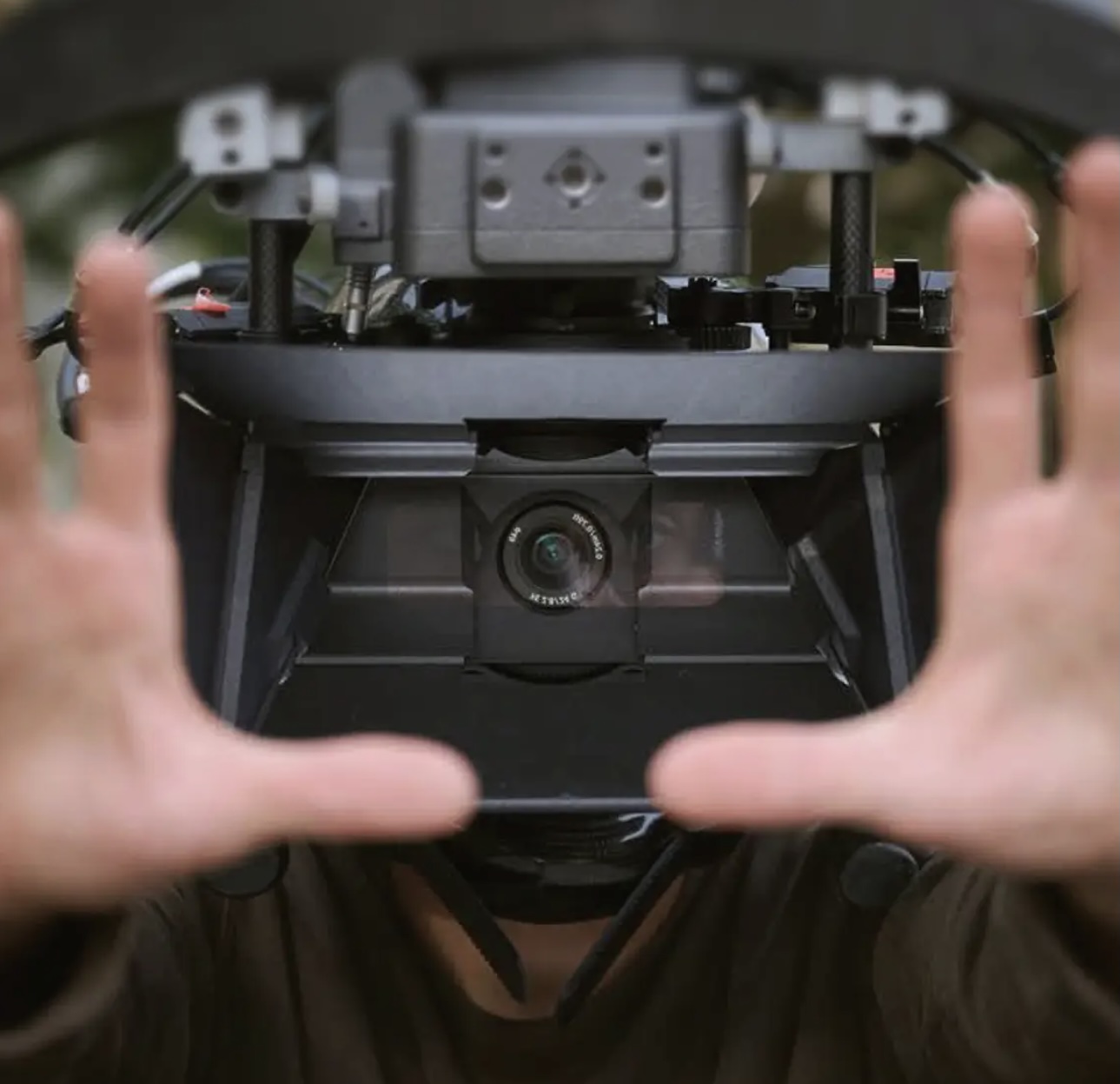
3D People case study details development of 3D-printed Cyclops POV camera rig using MJF and PA12

Hardware
Originally reported by 3DPrint.com
UK-based digital inventory platform and additive manufacturing service provider 3D People has published a case study detailing its work with cinematographer James Medcraft to develop and produce the Cyclops POV camera rig. The head-mounted system, designed to capture footage precisely matching the operator's natural field of view, is manufactured using HP Multi Jet Fusion (MJF) technology with PA12 nylon. 3D People, which operates a London facility focused on powder bed fusion and finishing, produced the rig's geometrically complex parts directly from CAD without tooling, enabling rapid iteration cycles measured in days rather than weeks. The Cyclops rig is built around the Sony E-Mount and is compatible with Venice Rialto or FX3 camera extension systems, using custom optics to reflect the operator's view into the camera while leaving hands free.
This case study illustrates a recurring but often overlooked segment of the AM services market: low-volume, geometrically complex, design-evolving production for specialized professional equipment. The film and broadcast vertical, while small compared to aerospace or medical, represents a demand pattern where AM's value proposition - no minimum order quantities, no tooling costs, rapid design iteration - directly addresses the limitations of traditional manufacturing. 3D People positions itself within the UK service bureau landscape as a production-grade parts provider, differentiating through finishing quality and customer-specific engineering support rather than raw machine capacity. The use of PA12 via MJF is standard for functional prototypes and end-use parts requiring isotropic strength and design freedom, but the application's specificity - a head-mounted rig requiring tight packaging, weight balance, and optical alignment - demonstrates the kind of problem-solving that separates capable service bureaus from commodity print farms.
For 3D People, the Cyclops project reinforces its capability to serve niche professional markets where design iteration speed and part complexity outweigh unit cost considerations. The company's challenge is scaling this model beyond one-off projects into repeatable revenue streams across multiple verticals. For potential customers in film, broadcast, or similar low-volume precision equipment markets, the case study provides a concrete reference point for evaluating whether AM can replace machined or molded components in their own evolving designs. The real test will be whether 3D People can convert this reference into a pipeline of similar projects without overextending its finishing capacity.
This article is an AI-assisted rewrite of the linked source report. Facts originate from the source; phrasing is AMPulse's. Use Read Original below to verify, or Report an issue if something is wrong.