3D Systems' Elmet Technologies installs DMP Flex 350 Triple to print C103 hypersonic heat exchangers, targets 2026 production

Hardware
Originally reported by 南极熊3D打印网
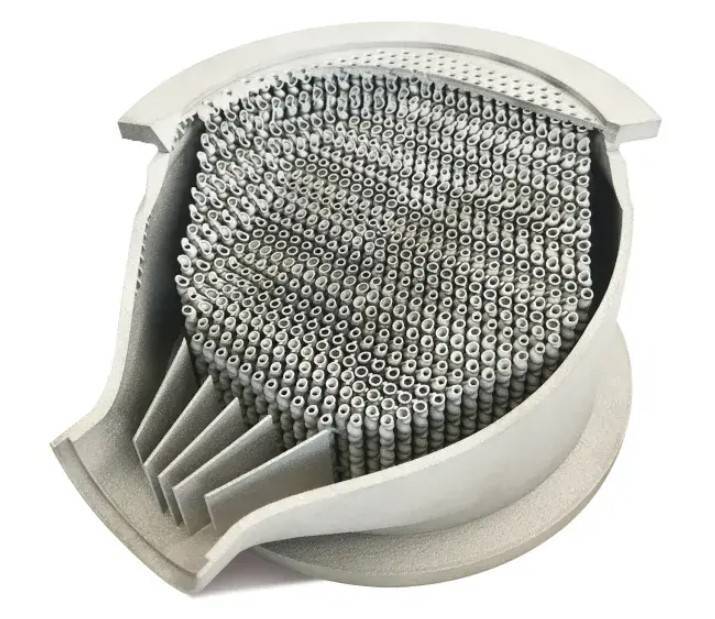
3D Systems subsidiary Elmet Technologies is installing a DMP Flex 350 Triple metal 3D printer to produce monolithic heat exchangers for hypersonic vehicles in C103, a niobium-hafnium-titanium refractory alloy. The deployment follows eight years of joint development between Elmet and 3D Systems' Application Innovation Group to establish reliable LPBF print parameters for the alloy, and 3D Systems expects system certification and production to begin in 2026. The three-laser DMP Flex 350 Triple builds parts up to 350 x 350 x 350mm and holds chamber oxygen below 25 ppm, typically 0 to 6 ppm, against roughly 210,000 ppm in ambient air. That low-oxygen environment lets Elmet reuse C103 powder across multiple builds without degrading material properties, a meaningful cost lever given powder priced near $4,000 per kilogram, per Auburn University's NCAME.
Printing a heat exchanger as a single part removes the alignment, filler-metal and furnace-brazing steps of conventional assembly, along with the joints that become failure points under extreme thermal cycling, and it opens up thin walls and high surface-area-to-volume geometries that brazed builds cannot match. Elmet also frames in-house production as a way to reduce dependence on a small pool of refractory-metal suppliers and processors, positioning it as localized capacity for the US defense industrial base. The qualification challenge is not unique to 3D Systems: Velo3D is separately pursuing C103 certification with Amaero-supplied powder on its Sapphire printer, and NCAME has confirmed C103 meets ASTM F3635 Grade B after a 1,200C heat treatment, evidence that a repeatable production workflow for this alloy remains a shared industry hurdle rather than a solved problem.
The shift from qualification work to installed production equipment follows 3D Systems' disclosure last month that Elmet was advancing C103 on the same three-laser platform toward certification, suggesting most of the eight-year qualification effort is now behind the 2026 production target.
This article is an AI-assisted rewrite of the linked source report. Facts originate from the source; phrasing is AMPulse's. Use Read Original below to verify, or Report an issue if something is wrong.
Topics