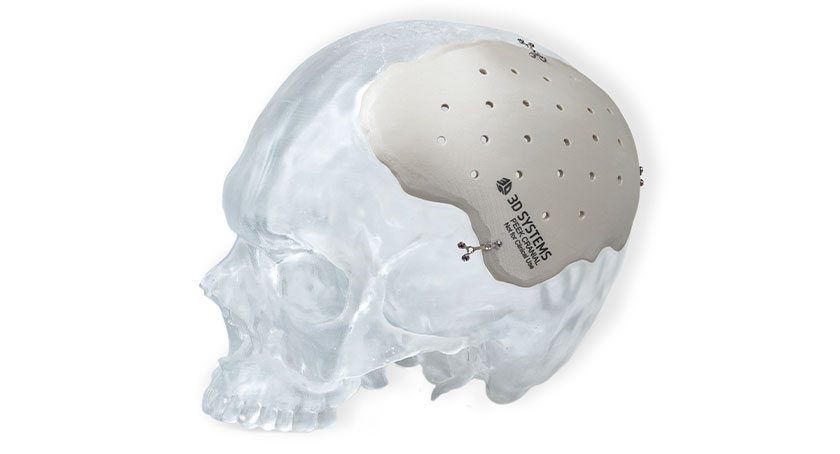
3D Systems supports first FDA-cleared point-of-care titanium cranial plate at Walter Reed (K253116)

Hardware
Originally reported by 3D ADEPT
3D Systems backed Walter Reed National Military Medical Center's 3D Medical Applications Center (3D MAC) through FDA premarket clearance of the Titanium Cranial Plate (TCP) System under 510(k) K253116. The patient-specific titanium implant, designed by Dr Peter Liacouras, reconstructs complex cranial and facial defects for active-duty personnel and war fighters and is described as the first implant cleared for a point-of-care institution. Across a multi-year effort begun in 2020 with VA Puget Sound quality-system work, 3D Systems contributed process controls, device design optimization, additive manufacturing workflows, and regulatory strategy. The Defense Health Agency's Office of Regulated Activities sponsored the 510(k), which cleared on the first attempt.
From 3D Systems' side, the win is a medical metal AM reference that embeds the OEM in qualified clinical production rather than a one-off machine placement. Point-of-care titanium implant manufacturing has been limited less by printability than by who owns the quality system and the FDA file; here a military clinical site carried both, with the OEM supplying the compliance and workflow stack that made ownership credible. Integrated fixation bars and in-house CT-to-design-to-manufacture at 3D MAC show where OEM differentiation concentrates once a cranial plate family is cleared: process control, design optimization, and regulatory scaffolding. The arrangement also seats 3D Systems inside Defense Health Agency and VA quality infrastructure, denser than commercial hospital outsourcing alone.
Near-term execution is hub-and-spoke: Liacouras plans to enroll other military facilities as contract designers under 3D MAC's quality management system, sending design files to Walter Reed for manufacture. That multiplies 3D Systems' workflow and control footprint without each satellite running its own 510(k). 3D MAC's stated follow-ons-a PEEK implant and a custom titanium ridge-augmentation matrix-extend the same partnership logic if they reuse the control architecture already cleared for TCP.
This article is an AI-assisted rewrite of the linked source report. Facts originate from the source; phrasing is AMPulse's. Use Read Original below to verify, or Report an issue if something is wrong.
Topics