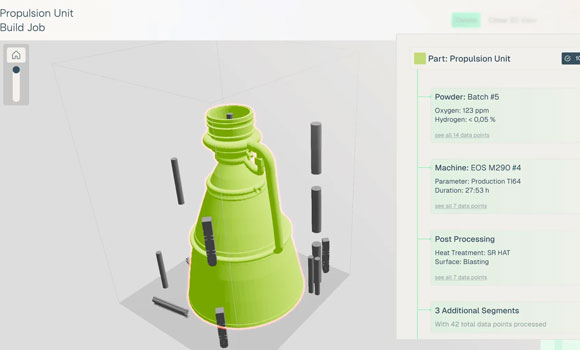
amsight highlights data-driven quality management for production-scale AM

Software
Originally reported by Metal AM
Hamburg-based software company amsight is positioning its digital quality management platform as a critical enabler for production-scale Additive Manufacturing, as the industry shifts from proving part producibility to demonstrating process capability and repeatability. In a recent release, Harry Kleijnen of Additive Center, who works with full-process data capture initiatives alongside Melotte, described how production data is often scattered across machine logs, powder records, post-processing documentation, and inspection spreadsheets, forcing manual reconstruction during non-conformance investigations. amsight’s platform links powder, process, and quality information at the part level, enabling automated audit trails and faster reporting cycles. Kleijnen emphasized that the goal is to move from manual “Excel heroics” to a system where operators can “press on the button to get a complete audit trail of your products.”
This announcement lands in a market where the value chain is increasingly governed by data integrity rather than raw machine throughput. For regulated verticals such as aerospace and medical, where qualification documentation can consume more time than production itself, the ability to connect process variation to critical-to-quality factors is becoming a competitive differentiator. amsight competes in the software-service segment alongside platforms like Link3D, Oqton, and Materialise’s Streamics, but its focus on linking powder genealogy, process parameters, and post-processing data into a single audit-ready record addresses a specific pain point that general MES systems often leave fragmented. The company’s approach aligns with the broader industry pattern where materials governance and quality infrastructure matter more than machine theater, especially as metal PBF-LB moves toward serial production in aerospace and consumer electronics.
Practically, amsight’s value proposition depends on whether it can integrate with the machine OEMs and inspection hardware that dominate existing factory floors, rather than requiring a greenfield data environment. The company’s next execution challenge is proving that its platform reduces non-conformance investigation time by a measurable margin in a live production setting, not just in pilot demonstrations. For buyers evaluating quality management software, the key question is whether the platform supports the specific machine brands and post-processing equipment already in their fleet, and whether the audit trail it generates satisfies the documentation standards of their target certification bodies.
This article is an AI-assisted rewrite of the linked source report. Facts originate from the source; phrasing is AMPulse's. Use Read Original below to verify, or Report an issue if something is wrong.
Topics