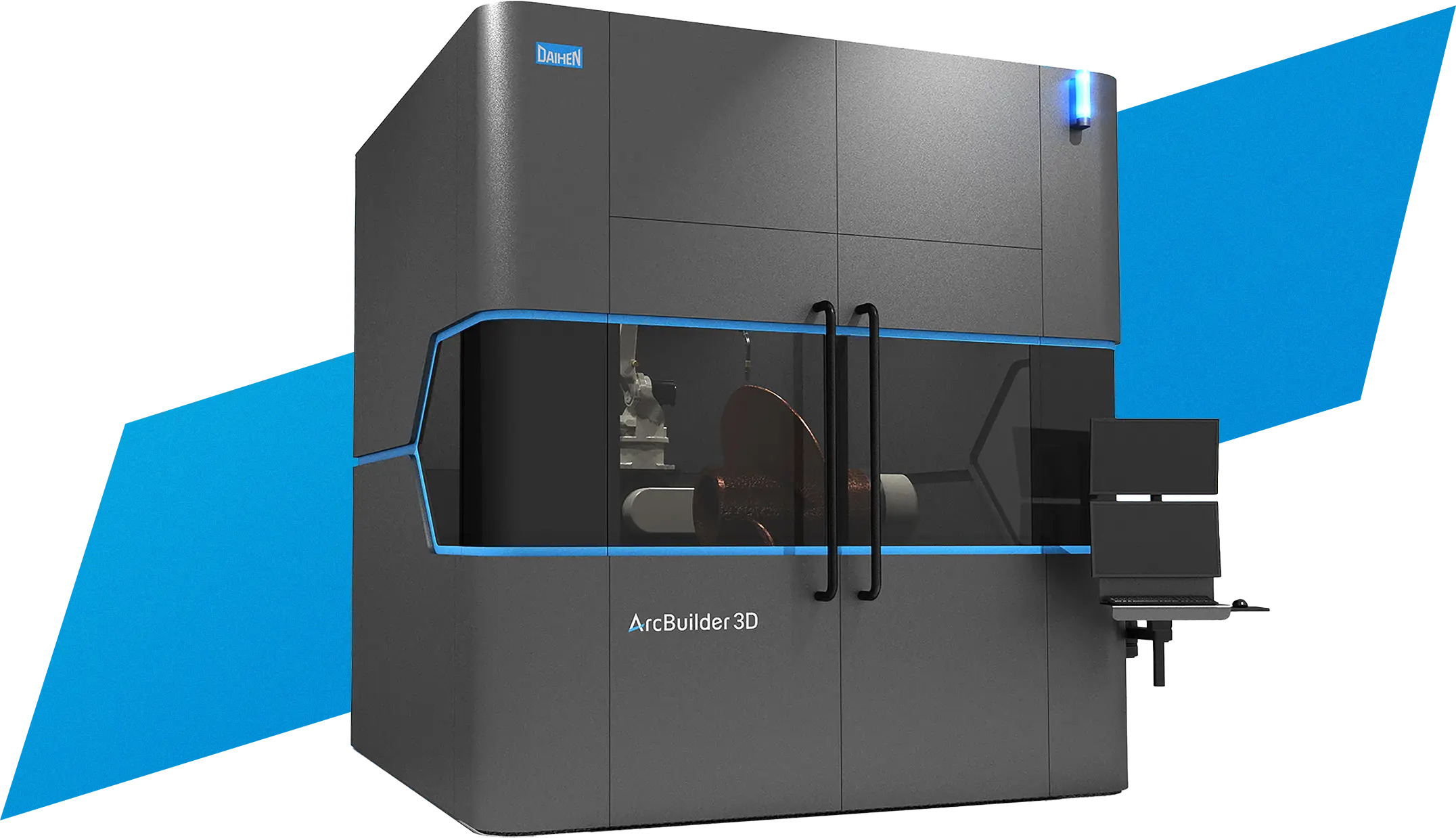
DAIHEN enters WAAM with ArcBuilder 3D wire-arc DED system priced at about $450k–$500k

Hardware
Originally reported by 3D Printing Industry
Japanese heavy-electrical manufacturer DAIHEN Corporation has launched ArcBuilder 3D, its first additive manufacturing product: a wire-arc directed energy deposition (DED) system priced at about $450,000 to $500,000. Unveiled at Robot Technology Japan 2026 as a ready-to-use WAAM cell for large metal parts, it centers on DAIHEN's AC Synchro-Feed process, which synchronizes high-speed forward-and-backward wire feed with welding current. The company claims more than 98% less spatter than standard approaches, smoother surfaces with milder layer lines, and a 24% build-efficiency gain over conventional welding. The hardware pairs a robot arm with a positioner, switches waveforms by alloy across steel, stainless steel, and aluminum, and ships with CAD-to-path software plus build-history monitoring; demo parts included rocket nozzles, propellers, manifolds, and tanks.
DAIHEN is selling a turnkey machine rather than copying Lincoln Electric's service-bureau model. The US welding major, with more than $4 billion in 2024 revenue, entered AM in 2019 and now runs 26 WAAM systems 24/7 in Cleveland, Ohio, while DAIHEN develops both power source and robot in-house for tighter process control. That welding-stack ownership pattern is also visible on the demand side: Framatome opened a 6,000 m², €25 million additive center in Romans-sur-Isère using MX3D robotic WAAM for nuclear primary-circuit metal parts, after three years of qualification. Large-format wire DED is winning capital where arc pedigree and part pedigree travel together, not where machines alone are marketed.
For buyers, ArcBuilder's $450k–$500k price and ability to deposit onto existing components make repair, feature addition, and low-volume work a practical alternative to machining scrap or casting tooling. DAIHEN's real test is packaging materials recipes, monitoring data, and customer references so AC Synchro-Feed performance survives outside demo alloys and show-floor builds. Without that application-level qualification grind, the launch stays a capable cell rather than installed production capacity.
This article is an AI-assisted rewrite of the linked source report. Facts originate from the source; phrasing is AMPulse's. Use Read Original below to verify, or Report an issue if something is wrong.
Topics