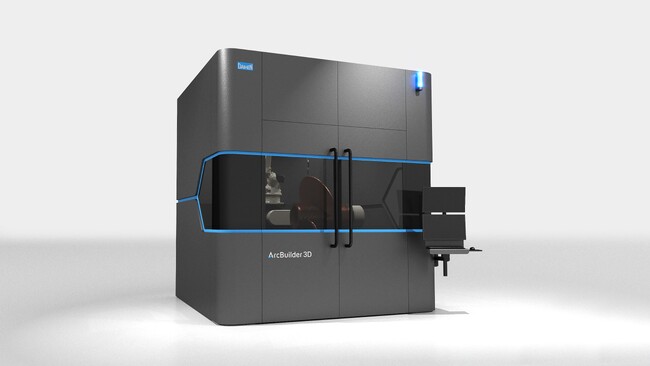
DAIHEN launches large-format metal DED 3D printer for ship propellers and rocket nozzles

Hardware
Originally reported by SEKAPRI
Osaka-based industrial equipment manufacturer DAIHEN has developed a large-format metal 3D printer targeting production of ship propellers, rocket nozzles, and fuel tanks. The system uses arc welding-based directed energy deposition (DED), melting metal wire rather than powder, which the company claims reduces manufacturing costs compared to conventional powder-bed metal AM. DAIHEN states the printer can deposit metal wire ten times faster than typical metal AM systems when fabricating a ship propeller. The machine is priced at ¥75 million (approximately $500,000 USD, excluding tax), with orders opening May 29, 2026. DAIHEN targets 20 unit sales in fiscal 2026 and will also offer a 3D printing service for prototype and production parts.
This launch places DAIHEN in the large-format metal DED segment, competing with players like WAAM3D, Lincoln Electric, and Meltio, but with a specific focus on maritime and aerospace propulsion components. The cost advantage over powder-bed fusion is significant for these applications, where buy-to-fly ratios are high and material waste reduction matters. DAIHEN leverages its existing industrial robotics and power supply expertise - the company has manufactured arc welding robots and plasma power sources for decades - giving it vertical integration advantages in the DED value chain. The target price point of ¥75 million positions it below many industrial metal PBF systems while offering substantially larger build envelopes suited to meter-scale parts.
From a practical standpoint, DAIHEN must now demonstrate that its arc-DED process can achieve the mechanical properties and repeatability required for marine classification society approvals and rocket-engine certification. The company's existing relationships with Japanese shipbuilders and aerospace primes provide a credible distribution channel, but qualification timelines in these verticals are measured in years, not quarters. The 20-unit sales target for fiscal 2026 is ambitious for a first-generation system in a conservative market; success will depend on early adopter references from the Japanese maritime and space sectors.
Topics