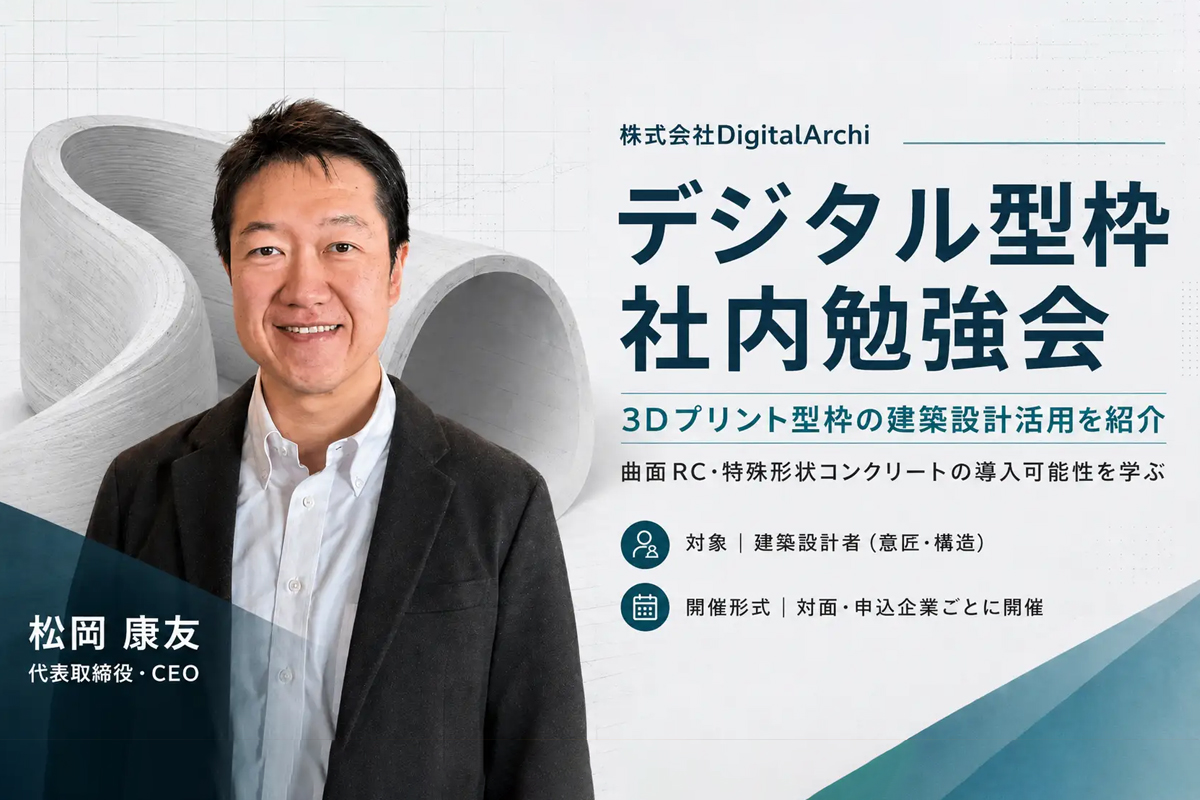
DigitalArchi launches on-site study sessions for architects on 3D-printed concrete formwork

Hardware
Originally reported by ShareLab
DigitalArchi, a Japanese construction technology company, has launched a new on-site study session program for architects and designers focused on its 3D-printed concrete resin formwork system, branded as 'Digital Formwork'. The sessions, conducted by the company's representative at the client's office, cover technical overviews, domestic and international case studies, and practical methods for integrating 3D-printed formwork into real projects. Attendees can examine physical samples of printed formwork and cast concrete to assess surface finish, layer lines, and segmentation strategies. The program targets architectural design firms, structural engineers, and BIM or computational design specialists working with complex geometries such as curved reinforced concrete, irregular slabs, and decorative elements.
This initiative addresses a persistent gap in the construction AM segment: the translation of digital design freedom into buildable structures. While BIM and parametric tools like Rhino and Grasshopper enable increasingly complex architectural forms, conventional timber or plywood formwork remains a costly and labor-intensive bottleneck for non-standard shapes. DigitalArchi's approach uses polymer 3D printing to produce custom formwork, effectively decoupling geometric complexity from fabrication cost. The study session model is a pragmatic service-led strategy - rather than selling printers or materials directly, the company invests in architectural education and workflow integration, lowering the adoption barrier for risk-averse design firms. This mirrors a broader pattern in AM where supplier-led training and qualification support are often more decisive than raw machine capability in driving real project uptake.
For DigitalArchi, the success of this program depends on whether it converts architectural curiosity into repeat project revenue. The construction AM market remains fragmented and project-based, with few standardized workflows. Architects and structural engineers need clear cost comparisons against conventional formwork, not just technical demonstrations. If DigitalArchi can document measurable time and cost savings from actual projects generated through these sessions, it will build a credible reference base that matters more than any single product launch.
This article is an AI-assisted rewrite of the linked source report. Facts originate from the source; phrasing is AMPulse's. Use Read Original below to verify, or Report an issue if something is wrong.
Topics