DigitalArchi provides 3D-printed formwork for AGB's GRC complex object manufacturing, advancing shape validation

Hardware
Originally reported by ShareLab
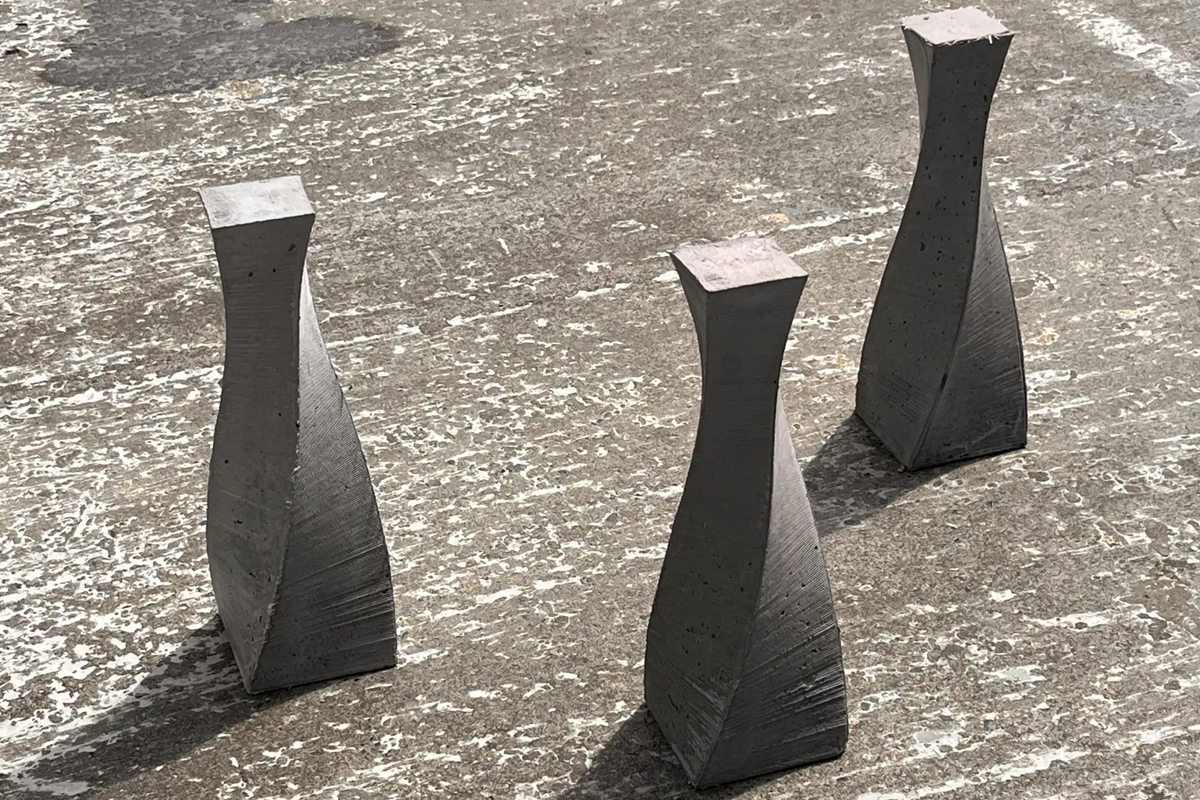
DigitalArchi, a Keio University spinout based in Tokyo, has delivered 3D-printed resin formwork to Asahi Building Wall Co. (AGB) for the production of a twisted, variable-thickness columnar object made from glass-fiber-reinforced concrete (GRC). The project, announced on May 26, 2026, involved four-part formwork assemblies, five or more reuse cycles, and iterative optimization of print data, joint sealing, and layer-line mitigation using sheet materials and tape. The collaboration aims to validate the practical combination of GRC and 3D-printed formwork for complex architectural geometries that conventional molding cannot economically produce.
This case sits at the intersection of architectural AM and industrial tooling, where the value lies not in printing the final part but in enabling the production of complex shapes in a mature material system like GRC. DigitalArchi's approach addresses a persistent gap in the construction AM segment: while direct concrete printing has garnered attention, formwork-based indirect methods offer lower risk for high-end architectural finishes and reuse economics. The project's emphasis on formwork reusability and surface-quality mitigation reflects a mature understanding that AM's role in construction is often as a tooling enabler rather than a direct production method. This aligns with the broader pattern of AM adoption in industrial tooling, where cost-per-part and surface finish remain the decisive metrics.
For DigitalArchi, the next step is converting these validation results into commercial projects with AGB or other architectural firms. The key challenge is scaling from a single bespoke object to repeatable workflows for large-scale building components, where formwork size, assembly precision, and material cost become constraints. For the construction industry, this demonstration reinforces that 3D-printed formwork is a viable bridge between digital design freedom and established GRC manufacturing, but the economic case depends on reuse frequency and the complexity premium that architects are willing to pay.
Topics