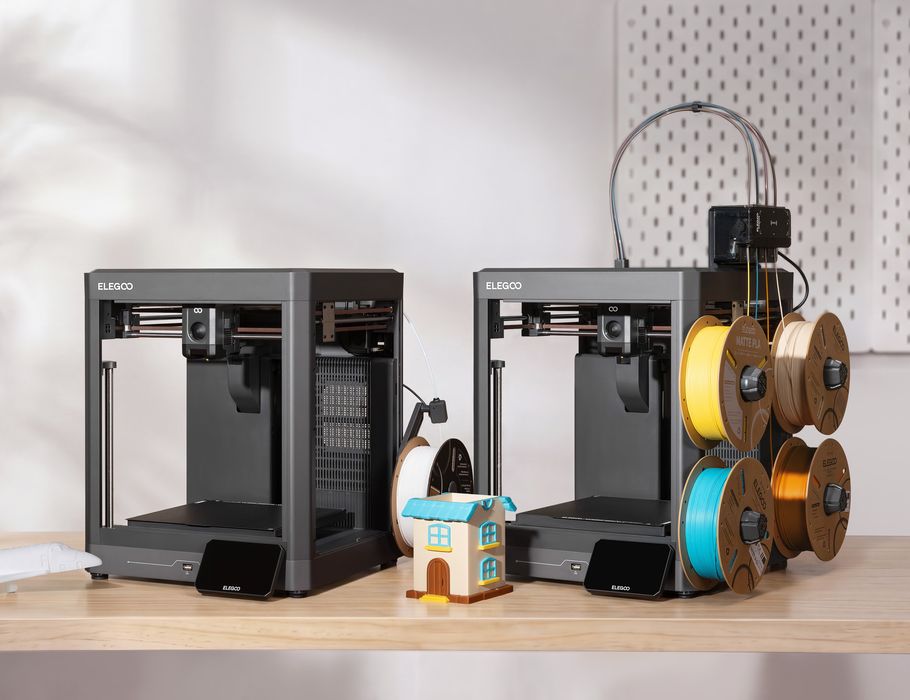
Elegoo Launches Centauri 2 Series at $299, Stripping Enclosure for Lower-Cost Desktop FFF

Hardware
Originally reported by Fabbaloo
Elegoo has announced the Centauri 2 and Centauri 2 Combo, a new series of desktop FFF 3D printers that strips down the company’s previous Centauri Carbon design to achieve a lower price point. The standard single-color version is priced at US$299, while the four-color combo variant costs US$349. Compared to the Centauri Carbon, the Centauri 2 removes the enclosure, onboard camera, lighting, and active cooling, and reduces the sensor count. Material compatibility is also narrowed: Elegoo does not recommend printing ABS, ASA, PET, PA, PC, or PETG-CF, but supports PLA, PETG, PLA-CF, and TPU - with TPU requiring a bypass adapter on the combo unit to avoid the CANVAS filament switcher.
This launch is a deliberate market segmentation move rather than a technology upgrade. The original Centauri Carbon reset price expectations for the desktop FFF segment by offering a well-featured enclosed machine at an aggressive price. The Centauri 2 now targets the even larger pool of hobbyist and prosumer users who do not need engineering-grade materials and prioritize absolute lowest cost over capability. In the broader polymer-MEX landscape, Elegoo is following the playbook established by Bambu Lab and Creality: offering a stripped-down variant of a flagship to capture price-sensitive buyers while maintaining the premium halo product above. The Centauri 2 does not introduce new technical frontiers - it is a tactical price-tier expansion within an already crowded desktop FFF market.
For buyers, the Centauri 2 is a straightforward value proposition: if you print only PLA, PETG, or TPU and want multi-color capability at $349, this is the cheapest path to that feature set. The trade-off is real - no enclosure means no high-temperature materials and less consistent chamber conditions for warp-prone filaments. Elegoo’s execution risk lies in whether the open-frame design introduces print-quality variability that the original Centauri Carbon avoided. Users should verify that the 22 remaining sensors deliver reliable first-layer detection and runout handling before treating this as a production tool rather than a hobby machine.
Topics