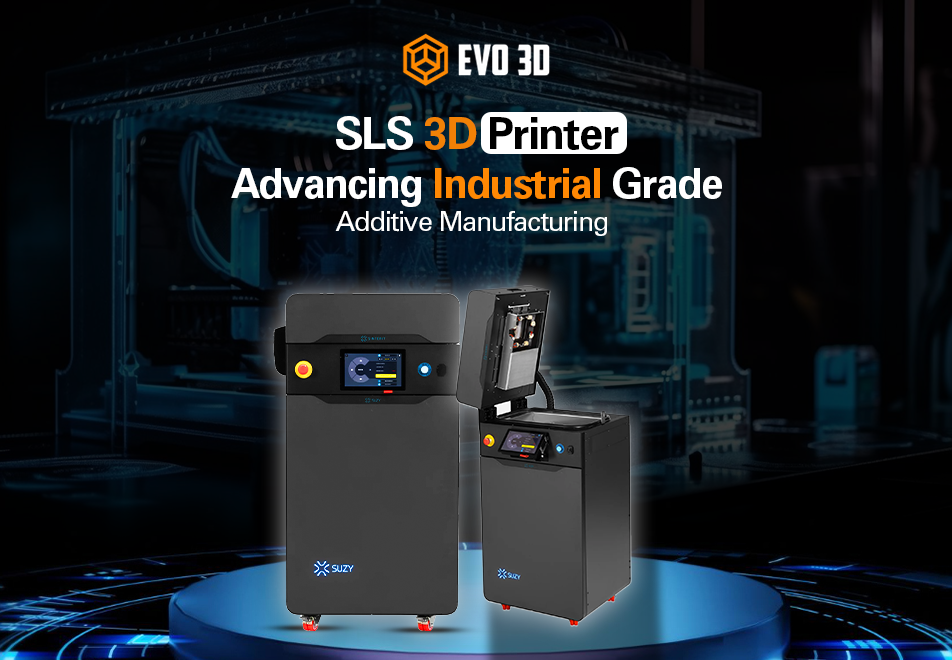
Evo3D publishes technical overview of industrial Selective Laser Sintering (SLS) capabilities for production-grade additive manufacturing.

Hardware
Originally reported by evo3d.co.uk
Evo3D publishes technical overview of industrial Selective Laser Sintering (SLS) capabilities for production-grade additive manufacturing. The UK-based distributor highlights the transition of SLS from prototyping to end-use manufacturing, emphasizing the mechanical advantages of powder-bed fusion for polymers like PA12. The analysis focuses on the economic shift from equipment-centric procurement to total lifecycle cost evaluation, including labor reduction and post-processing efficiency. Evo3D outlines how the absence of support structures in SLS allows for complex geometries, such as internal channels and lattice structures, which are critical for aerospace and automotive applications.
This technical briefing underscores the increasing demand for high-repeatability polymer AM systems in the European industrial sector. While competitors like EOS and Formlabs dominate the high-end and desktop-to-benchtop segments respectively, Evo3D positions itself as a strategic partner for firms navigating the integration of SLS into existing production workflows. The focus on long-term ROI over initial capital expenditure reflects a broader market trend where manufacturers prioritize material utilization and assembly consolidation to justify the higher entry cost of industrial SLS hardware compared to FDM/FFF systems.
For industrial buyers, the value of this analysis lies in the shift toward evaluating production efficiency metrics rather than simple machine pricing. Companies should focus on quantifying the reduction in assembly complexity and tooling costs when assessing the feasibility of adopting SLS for medium-volume production runs. Successful implementation requires a rigorous assessment of part geometry requirements and material performance specifications to ensure the technology delivers the necessary mechanical properties for end-use applications.
Topics