funovo launches 'Shapey' 3D-printed architectural model service in Hakodate, Japan

Service
Originally reported by ShareLab
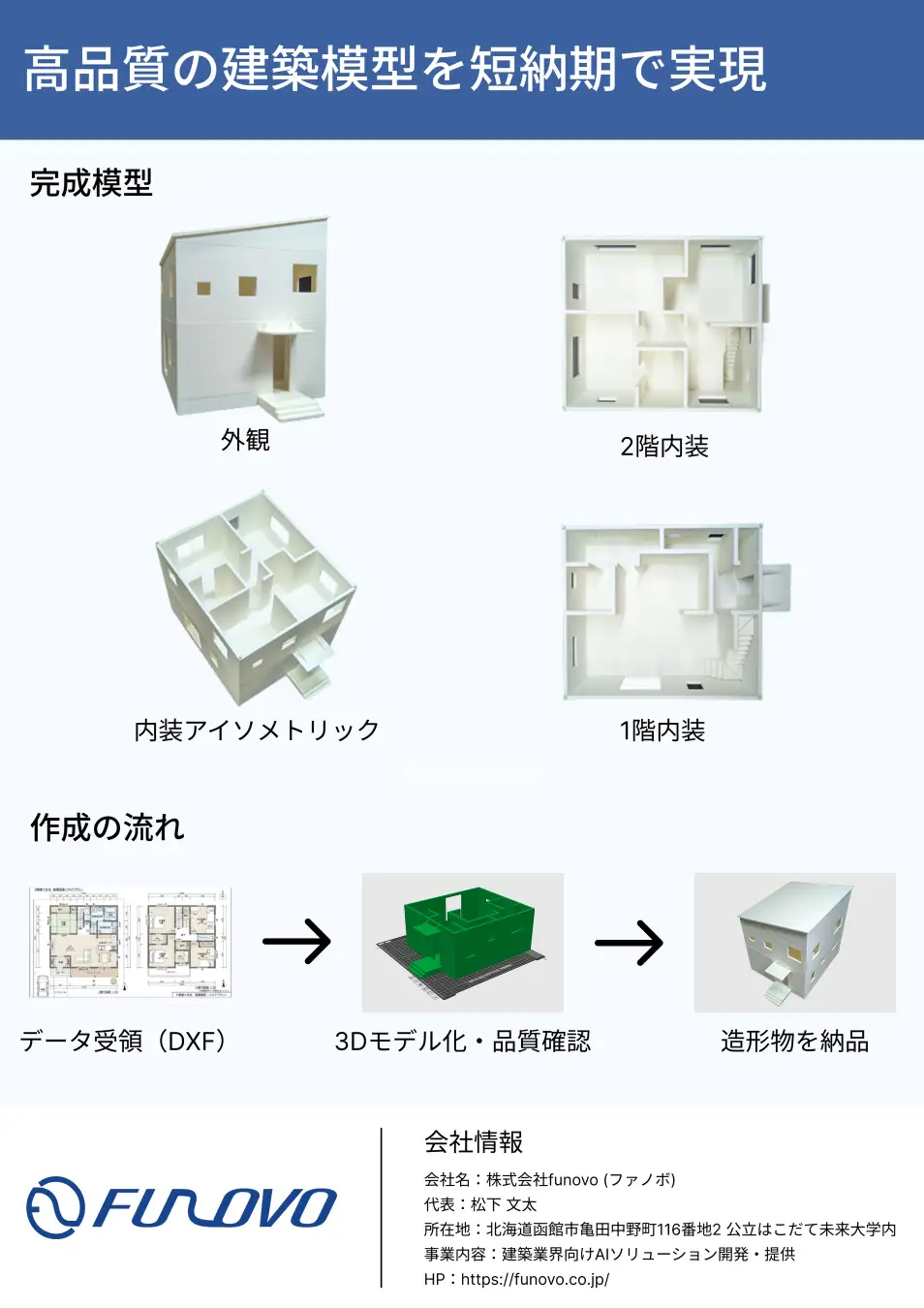
Hakodate-based funovo has launched 'Shapey,' a 3D-printed architectural model service targeting local construction firms and design offices in Japan. The service accepts standard 2D CAD data or PDF floor plans, converts them into 3D models, and delivers physical prints within approximately one week starting at ¥35,000 (roughly $230). Customers can preview the 3D model on a dedicated web viewer before printing, and funovo is offering a ¥5,000 discount on first orders along with free on-site demonstrations in the Hakodate area. The company uses unspecified latest-generation 3D printers to achieve dimensional accuracy and larger model sizes compared to traditional handcrafted models at the same price point.
This launch fits the recurring pattern of localized service bureaus using polymer AM to digitize traditional craft workflows - in this case, architectural model-making, which remains labor-intensive and costly for small builders. The service addresses a clear pain point: Japanese construction firms, especially in regional markets like Hokkaido, often lack in-house model-making capacity and face high outsourcing costs. By removing the need for 3D modeling expertise and offering a web-based preview tool, funovo lowers the adoption barrier for a non-technical customer base. The move is structurally similar to other regional AM service plays in Japan - such as Meltha's '3D Print Express' - but narrows the focus to a single vertical, which may improve unit economics and customer acquisition efficiency. The service sits in the polymer-vpp or polymer-mex process segment, depending on the printer technology used, and targets the industrial-tooling and construction verticals through architectural presentation models rather than structural components.
For funovo, the key execution challenge is scaling beyond Hakodate while maintaining the one-week turnaround and price point. The service's viability depends on repeat orders from local builders and design offices, not one-off projects. Buyers should verify material quality and surface finish against their presentation standards before committing to volume use. This is a small, vertical-specific service launch - not a market inflection - but it demonstrates how AM can incrementally displace manual craft in regional construction workflows.
This article is an AI-assisted rewrite of the linked source report. Facts originate from the source; phrasing is AMPulse's. Use Read Original below to verify, or Report an issue if something is wrong.