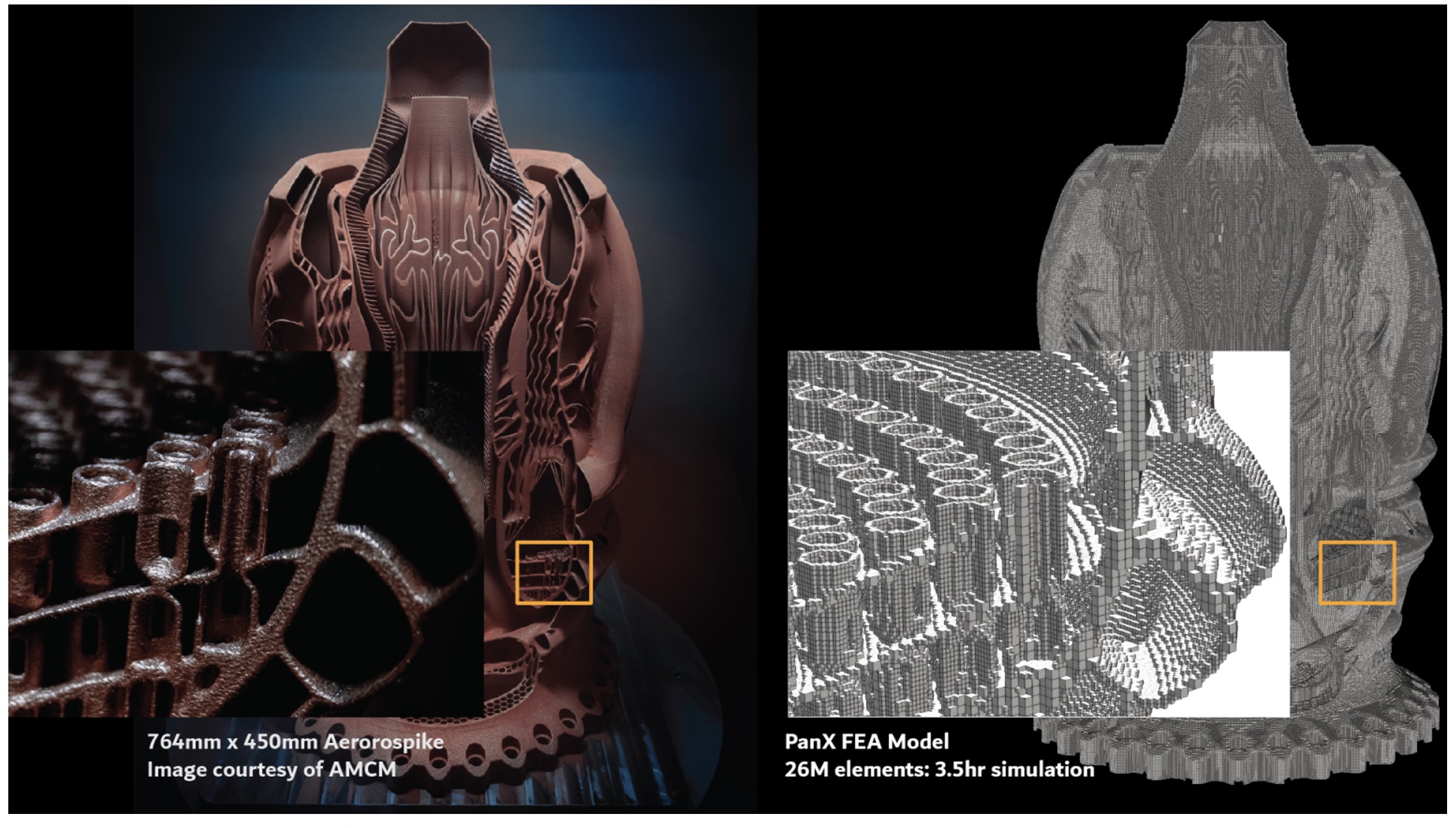
PanOptimization's PanX software simulates billion-element metal AM builds on standard workstations

Software
Originally reported by 3Druck
PanOptimization, a metal additive manufacturing simulation software developer, has detailed its PanX platform's ability to handle what it terms the "too large, too complex" class of metal AM components. Principal Engineer Evan Butcher explained that PanX uses periodic adaptivity and multi-grid modeling to mesh and simulate finite element analysis (FEA) models that are 100 to 1,000 times larger than traditional approaches can manage, enabling hundreds of millions to billions of elements on an engineering workstation. The software targets production parts on large-format multi-laser systems like the AMCM M 4K (450 × 450 × 1000 mm build volume), where the cost of a failed print is prohibitive and accurate simulation is critical for warpage and temperature prediction.
This development addresses a structural bottleneck in the metal AM value chain: the gap between simulation software capability and production-scale hardware. Many first-generation simulation tools hit a practical upper limit of roughly 5 million elements, forcing engineers to simplify geometries or abandon simulation altogether for large, complex parts. PanX's approach directly tackles this scaling limit, targeting the segment of users who have already invested in large-format LPBF systems but lack the digital tools to simulate production parts without resorting to costly trial-and-error printing. The company positions itself in the software layer of the AM workflow, competing with established players like Ansys Additive, Simufact, and Autodesk Netfabb, but claims a distinct advantage in handling the geometric complexity and scale of real production components rather than simplified research models.
PanOptimization's claim is specific and testable: that its solver can handle billion-element models on standard hardware without sacrificing accuracy. The practical test will be whether the software integrates into existing engineering workflows and delivers simulation results within production scheduling timelines, not just in R&D. For users of large-format LPBF systems, the key question is whether PanX reduces the iteration cost on high-value builds enough to justify the software investment and workflow change.
This article is an AI-assisted rewrite of the linked source report. Facts originate from the source; phrasing is AMPulse's. Use Read Original below to verify, or Report an issue if something is wrong.