Instalimb receives investment from Orthomoss Group to co-develop 3D-printed prosthetic and orthotic solutions
Hardware
Originally reported by ShareLab
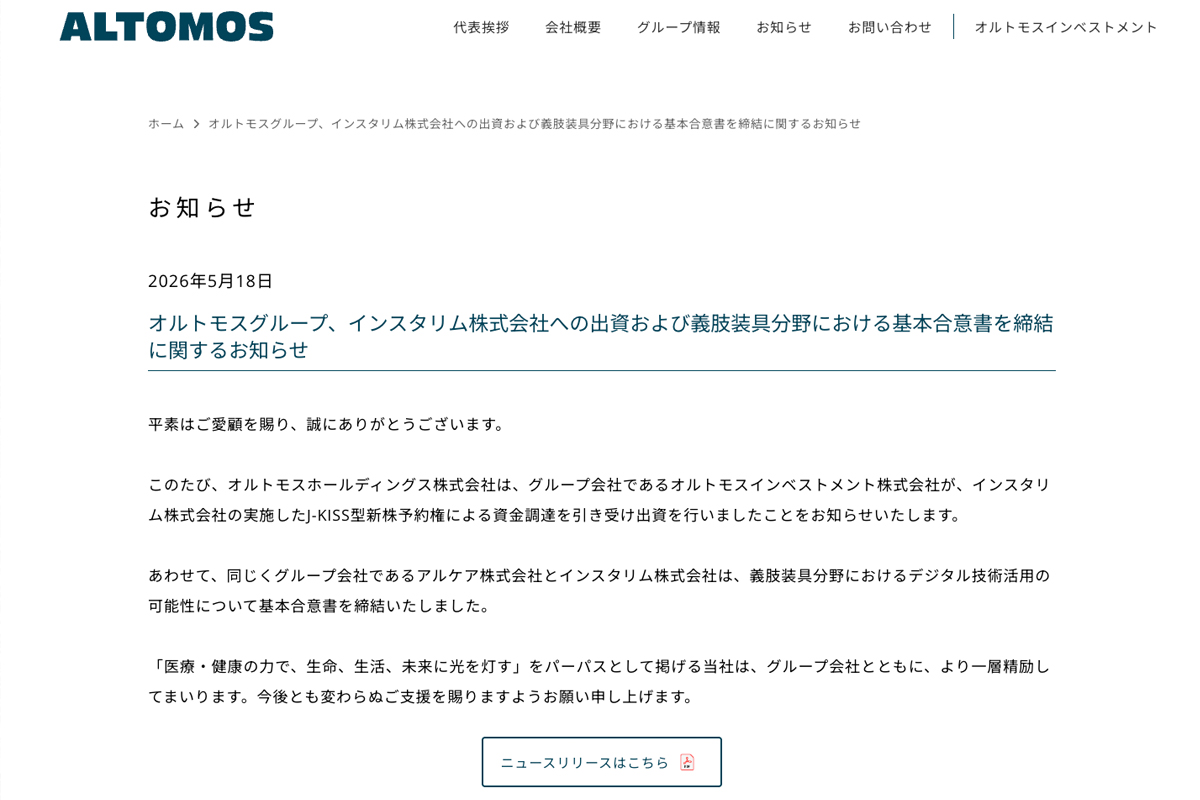
Instalimb Inc., a Japanese startup specializing in AI-driven, 3D-printed prosthetic solutions, has secured an investment from Orthomoss Investment Co., Ltd., a subsidiary of the Orthomoss Group. The funding was structured as a J-KISS type equity warrant issuance. Concurrently, Instalimb signed a basic agreement with Alcare Co., Ltd., another Orthomoss Group company, to jointly explore digital manufacturing for prosthetic sockets, orthotics, and welfare equipment. The partnership targets three areas: developing adjustable prosthetic sockets using AI and 3D printing, applying digital fabrication to orthotics and long-term care devices, and evaluating market entry into Japan.
This deal fits a recurring pattern in the medical-dental vertical where digital fabrication startups partner with established medical-material incumbents to bridge the gap between prototyping and clinical deployment. Instalimb’s core value proposition - a fully digital workflow from AI-based design to 3D printing - addresses a structural bottleneck in prosthetics: the reliance on manual labor by skilled prosthetists, which limits throughput and drives cost. By combining Instalimb’s digital manufacturing platform with Alcare’s expertise in skin-contact materials and clinical networks, the partnership moves beyond simple part production toward a complete care-delivery model. This mirrors the broader trend in polymer-vpp and polymer-mex segments where material science and patient-specific design are becoming the differentiators, not just printer hardware.
From an industry perspective, the practical challenge here is not whether Instalimb can print a socket - that is already proven - but whether the combined entity can navigate Japan’s conservative medical-device qualification environment and build a sustainable service model. The global addressable market for assistive devices is enormous, but adoption in high-income countries like Japan will require regulatory clearance, reimbursement pathways, and clinician training. Instalimb’s existing operations in the Philippines and India provide a low-cost proving ground, but the Japanese market demands a different level of evidence and integration. The next 12 months will reveal whether this partnership can convert a promising digital workflow into a reimbursed clinical product.
This article is an AI-assisted rewrite of the linked source report. Facts originate from the source; phrasing is AMPulse's. Use Read Original below to verify, or Report an issue if something is wrong.
Topics