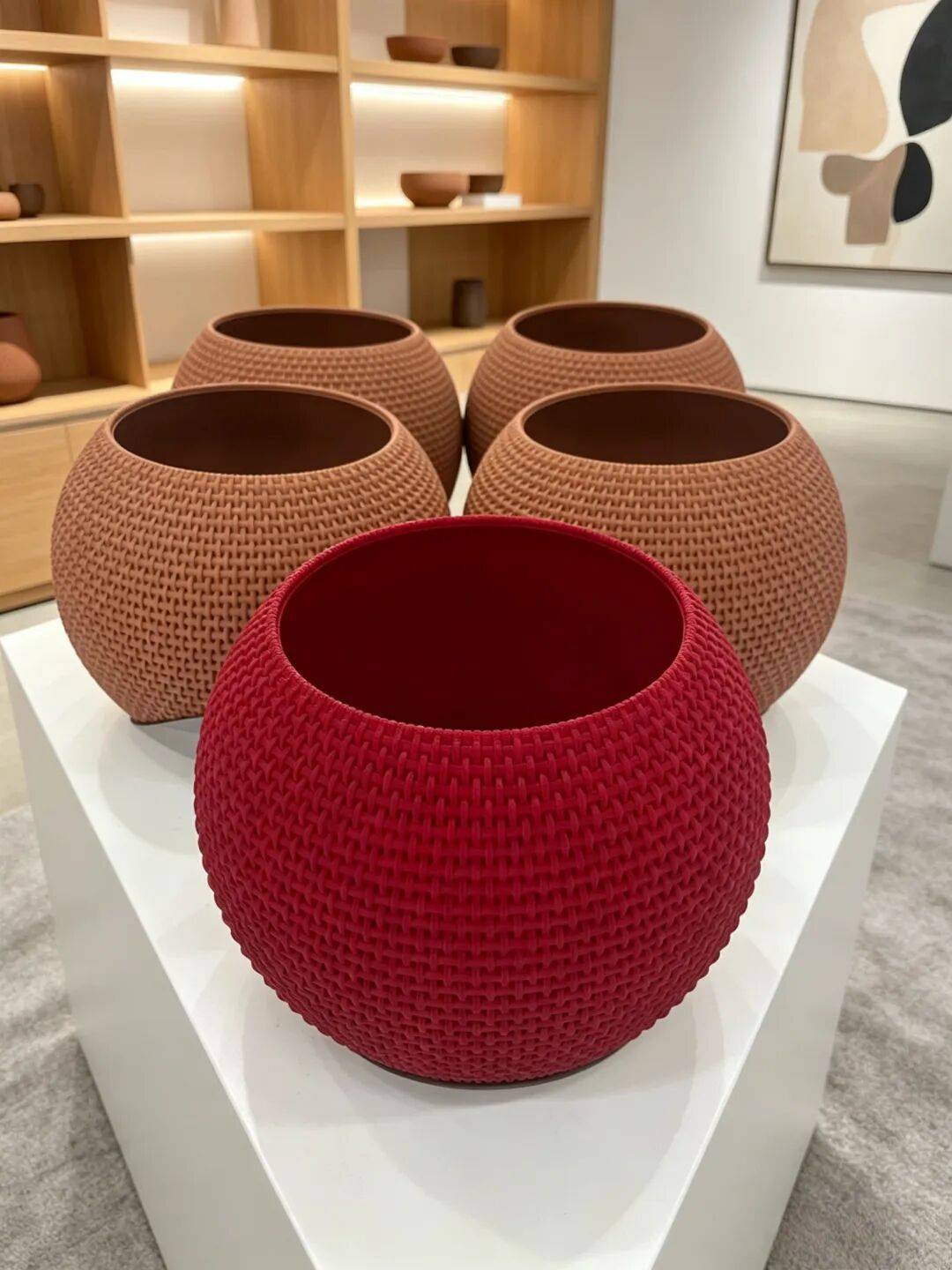
Jinshi Additive Manufacturing Industry College showcases student 3D prints at Ren'ai Tuanbo Lake Life Festival
Originally reported by 小城今天话多少
Jinshi Additive Manufacturing Industry College, a校企合作 (school-enterprise) collaboration between Tianjin Ren'ai College and Jinshi 3D Printing Co., Ltd., is presenting a student 3D printing works exhibition at the Ren'ai Tuanbo Lake Life Festival from May 1–5, 2026. The exhibition features a range of polymer FDM/FFF and SLA prints including woven-texture planters, auspicious animal figurines, articulated dragon models with gradient coloring, and detailed白虎 (white tiger) carvings. The college positions itself as a talent pipeline for additive manufacturing, integrating classroom learning with hands-on design-to-production workflows using desktop and industrial polymer systems.
This event is a localized, educational deployment of AM that mirrors the broader Chinese localization arc (P2) - where domestic institutions build supply-side capability through curriculum integration rather than hardware sales. The college's focus on polymer-based creative and decorative objects places it in the consumer and文创 (cultural creative) vertical, a segment where Chinese AM adoption is accelerating through low-cost FDM/SLA ecosystems from companies like Bambu Lab, Creality, and Anycubic. Unlike industrial metal AM qualification programs in aerospace or medical, this exhibition targets public awareness and design talent cultivation, filling a gap in the AM workforce pipeline that Western institutions like MIT or Fraunhofer have long addressed. The event itself is a festival tie-in, not a trade show, indicating that AM is being marketed as a lifestyle and educational tool rather than a production technology.
For the AM industry, this is a minor but structurally relevant signal: China's AM talent pipeline is expanding through regional college-industry partnerships, which will eventually feed into higher-value metal and production applications. The practical takeaway is that Jinshi and similar colleges are building a base of designers and operators who will enter the workforce in 2–4 years, potentially lowering the cost of AM adoption for Chinese manufacturers. No new hardware, materials, or production capacity was announced; the news is about workforce development, not market disruption.
This article is an AI-assisted rewrite of the linked source report. Facts originate from the source; phrasing is AMPulse's. Use Read Original below to verify, or Report an issue if something is wrong.
Topics