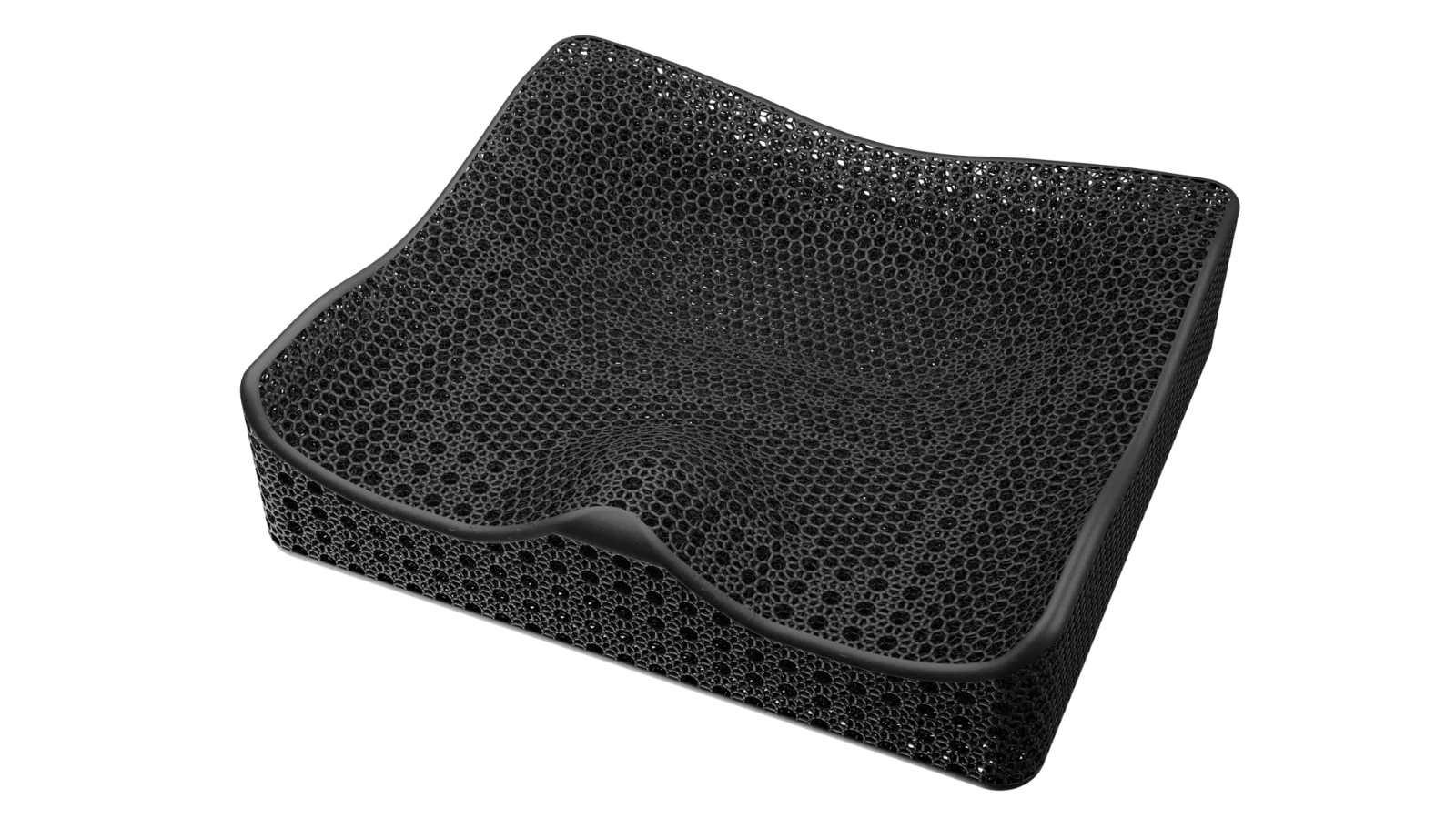
Kalogon launches Verro Lattice wheelchair cushion with zoned 3D-printed elastomer support

Hardware
Originally reported by 3Druck
Kalogon has launched the Verro range of custom wheelchair cushions for users with complex positioning and support needs, including pelvic tilt, asymmetrical seating and laterally shifted leg positions. The US manufacturer offers Verro Lattice, which uses a 3D-printed open-cell elastomer lattice with stiffness varied across the seating surface and sidewalls, alongside the non-printed Verro Foam option. By changing cell density and geometry, the company says it can place firmer stabilising zones beside more compliant areas intended to distribute pressure and relieve sensitive points.
The product is a practical medical-device application of polymer additive manufacturing: the value lies in tuning mechanical response within one cushion rather than merely matching an external body contour. That makes the lattice approach relevant where conventional homogeneous foam requires trade-offs between posture control, pressure management and ventilation. Kalogon also states that the hydrophobic lattice permits airflow and liquid passage, can be cleaned on a dishwasher’s top rack, and can weigh up to 900 g less than comparable products.
Both versions are manufactured in Melbourne, Florida, and offered under Medicare billing code E2609; the foam base can be further modified by seating professionals after delivery. The commercial test is whether this design freedom can fit established clinical assessment, reimbursement and adjustment workflows as reliably as it addresses a highly individual seating requirement.
Topics